How China’s Mobile Economy Is Entering a New Stage of Development

How China’s Mobile Economy Is Entering a New Stage of Development

The Center for Economic Research and Reforms (CERR) reviewed the GSMA Intelligence report The Mobile Economy China 2026, which views mobile connectivity not as a separate telecommunications sector, but as an infrastructural foundation for industry, artificial intelligence, public services, and energy.

In 2025, mobile technologies contributed $1.5 trillion to China’s economy, equivalent to 7.2% of GDP. By 2030, their contribution is projected to reach $2.11 trillion, or 8.4% of GDP.

China accounts for more than 40% of global 5G connections, and by 2030 the number of 5G connections in the country is expected to exceed 1.7 billion. Further growth will be driven primarily by the adoption of 5G-Advanced, mobile AI, edge computing, satellite networks, and 6G. At the same time, 94% of the economic impact is generated outside the telecommunications sector, including manufacturing, services, construction, agriculture, finance, and public administration.

Macroeconomic Context

In 2025, China’s economy grew by 4.7%, compared with 3.1% globally, although growth slowed noticeably compared with 2021.
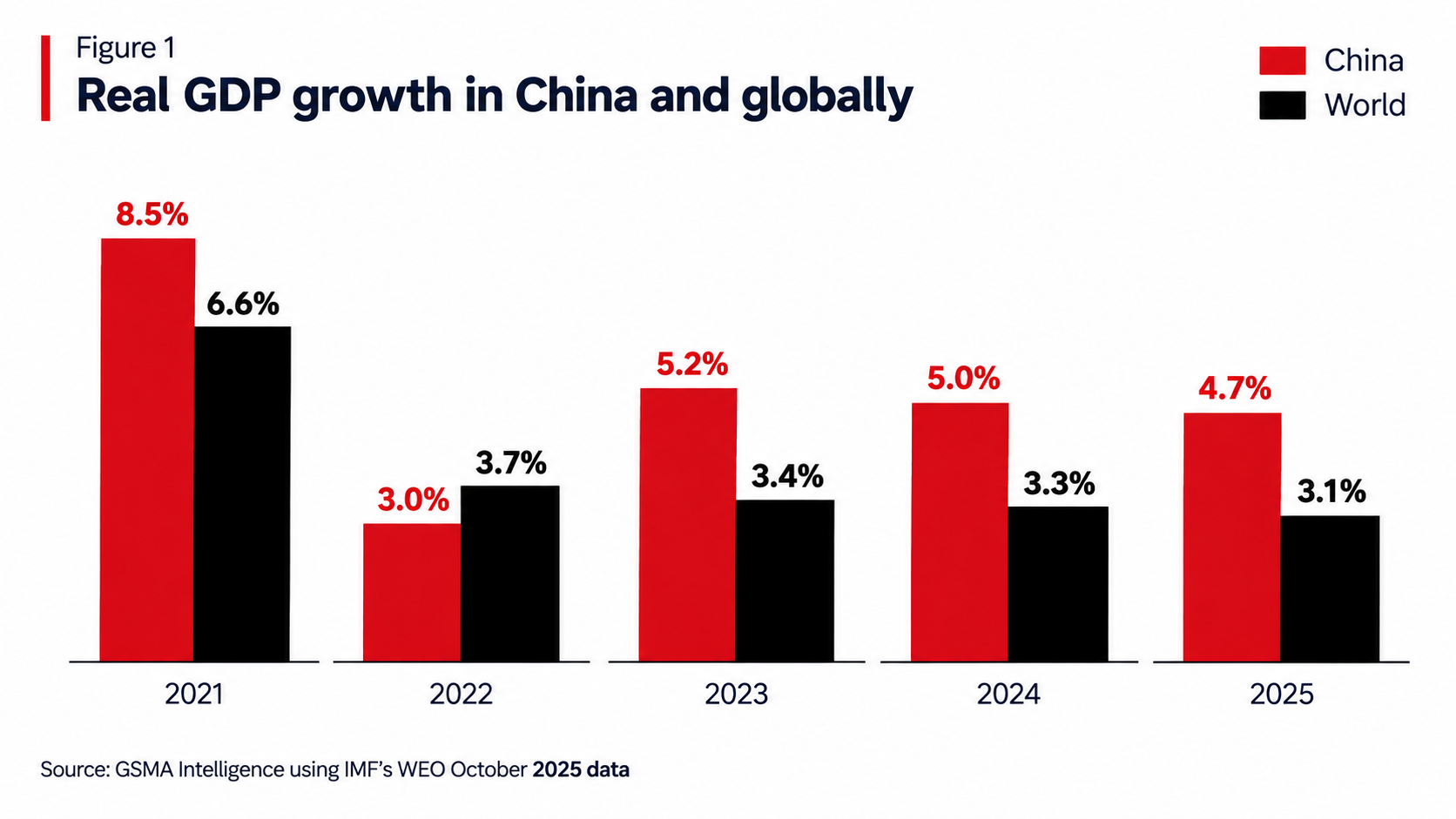
The main reasons are weak domestic demand, the real estate crisis, the debt burden of local governments, and subdued investment activity.

In 2026–2030, China is focusing on domestic demand, technological self-reliance, advanced manufacturing, semiconductors, artificial intelligence, and computing infrastructure. The contribution of mobile technologies to the economy is expected to increase from $1.5 trillion to $2.11 trillion, while their share of GDP will rise from 7.2% to 8.4%, reflecting a shift from expanding connectivity to improving economic productivity.

Digital Connectivity and the 5G Market

In 2024, internet coverage reached 91% of China’s population. While the coverage gap stood at around 1%, the usage gap remained at 8%, indicating a shift in priorities from network deployment toward developing digital skills, stimulating demand, and expanding the practical use of online services.

The share of 5G connections is expected to rise from 65% in 2025 to 88% by 2030. In mainland China, the number of 5G connections will reach around 1.7 billion, accounting for nearly one-third of the global total. The decline in China’s global share will reflect faster 5G adoption in other regions rather than a weakening of the domestic market.

Operator Revenues, Investment and Employment

Revenues of China’s mobile operators are projected to increase from $191 billion in 2025 to $222.8 billion in 2030, an increase of 16.6%. Capital expenditure over the five-year period will amount to $194.1 billion. Operator revenues are expected to grow by an average of 3.1% per year, while the overall economic impact of mobile technologies will grow by 7%, indicating that most of the value added will be generated outside the telecommunications sector.
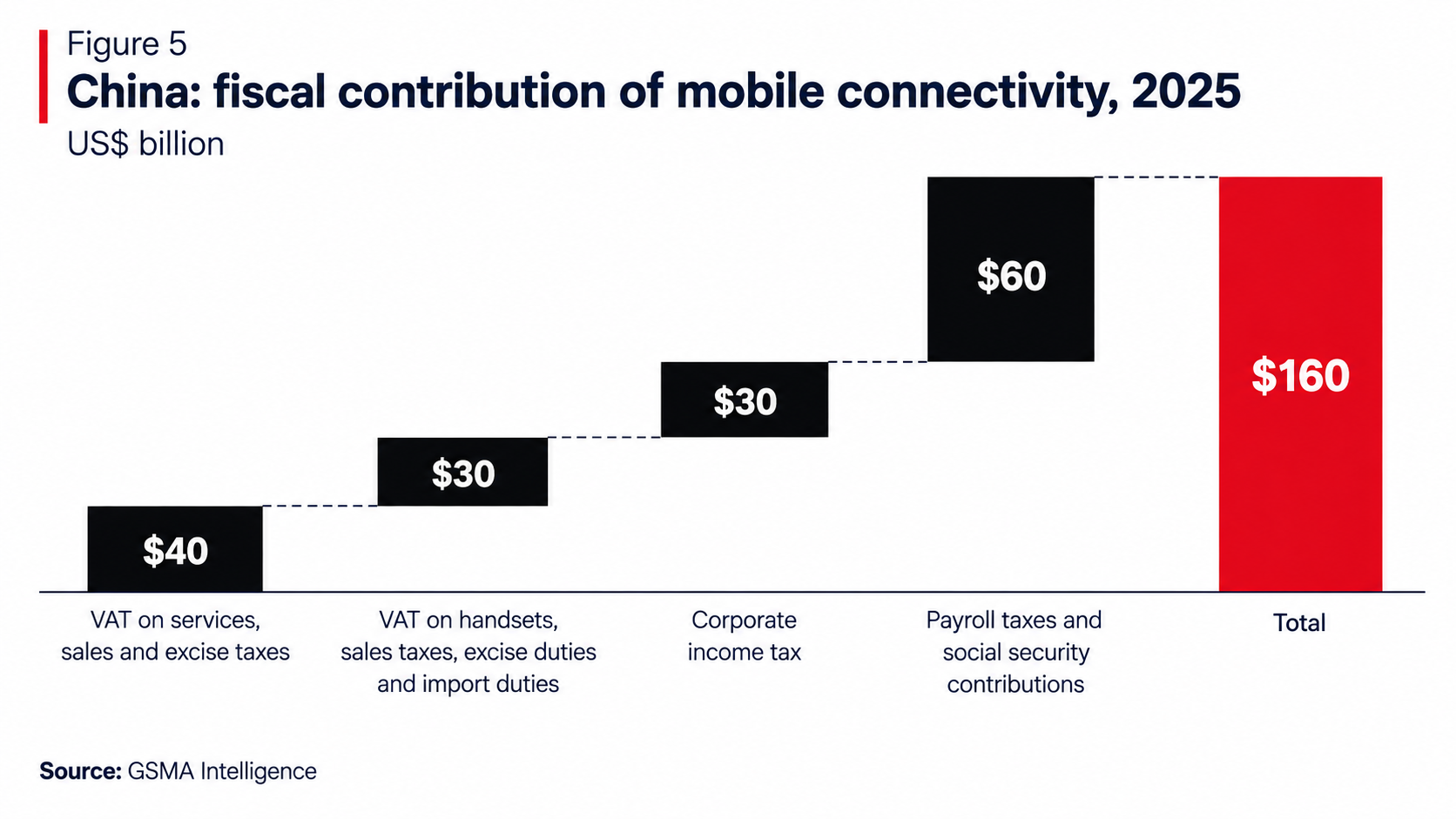
In 2025, the mobile ecosystem supported around 7.9 million jobs and generated $160 billion in tax revenues, equivalent to 5.8% of government revenues. Digitalization is expanding the tax base through employment, electronic payments, and greater transparency of economic transactions.

Cross-Sector Impact and Productivity Growth

In 2025, the direct contribution of China’s mobile ecosystem amounted to $380 billion, while the indirect contribution reached $130 billion. The productivity impact was significantly higher at $990 billion, accounting for 66% of the total economic impact. The contribution of infrastructure and equipment providers was 2.6 times that of mobile operators.

By 2030, 94% of the economic impact of mobile technologies will be generated outside the telecommunications sector. Industry and services will account for 59%, confirming that the main economic benefits of 5G arise from its integration with robotics, machine vision, intelligent logistics, and digital production management.

Satellite Connectivity and Non-Terrestrial Networks

By the end of 2025, China Telecom served 8.2 million users of direct satellite connectivity and more than 26 million connected devices, with the technology supported by over 40 smartphone models. BeiDou satellite services have entered the mass market, enabling the transmission of messages, voice, and images.

In 2026, semantic coding enabled voice and image transmission at speeds of just 2.8 kbps. Satellite connectivity also reached more than 100,000 vehicles, while filings for satellite constellations comprising more than 200,000 satellites reflect China’s move toward large-scale use of satellite technologies in transport, agriculture, energy, and emergency response.

Green Mobile Infrastructure

In 2025, China’s largest operators significantly improved the energy efficiency of digital infrastructure. China Mobile purchased 5.5 TWh of green energy and saved 15 TWh, reducing the PUE of its data centers to 1.285. China Telecom increased its use of clean energy by 56% and reduced emissions by more than 16 million tonnes. Network sharing between China Telecom and China Unicom saves around 24 TWh annually.

Some data centers already operate predominantly or entirely on renewable energy. A virtual power plant in Zhejiang integrated nearly 8,000 base stations, generating savings of RMB 28.3 million and reducing emissions by 30,000 tonnes. This demonstrates that telecommunications infrastructure is becoming both an energy consumer and a tool for managing the power system.

Spectrum Policy and the Prospects for 6G

In May 2026, China allocated the 6,425–7,125 MHz band for 6G trials, establishing spectrum as a strategic resource for technological development. Additional bands at 4.5 GHz and 7–8 GHz are expected to be considered in 2027, intensifying global competition for radio spectrum.

Mass deployment of 6G is expected to begin around 2030. By 2040, the number of connections could exceed 5 billion, with around 1.6 billion in China. To meet growing demand, the country will require up to 3.7 GHz of additional mid-band spectrum.

Uzbekistan’s Mobile Economy

Uzbekistan has largely completed the development of basic mobile coverage. Around 99% of the population is covered by mobile networks, 98% by mobile broadband, and approximately 97% by LTE networks.

In 2024, however, 5G coverage stood at only 18%, while 5G accounted for 4–5% of connections, and the network comprised around 54,200 base stations.

At the beginning of 2025, 30.1 million people used mobile services, equivalent to 81 mobile subscribers per 100 inhabitants, while there were 109 active internet subscriptions per 100 inhabitants.

In 2025, GDP grew by 7.7% to UZS 1,849.7 trillion, telecommunications services increased by 8.6% to UZS 22.6 trillion, while communications and information services expanded by 22.7% to UZS 79.5 trillion.

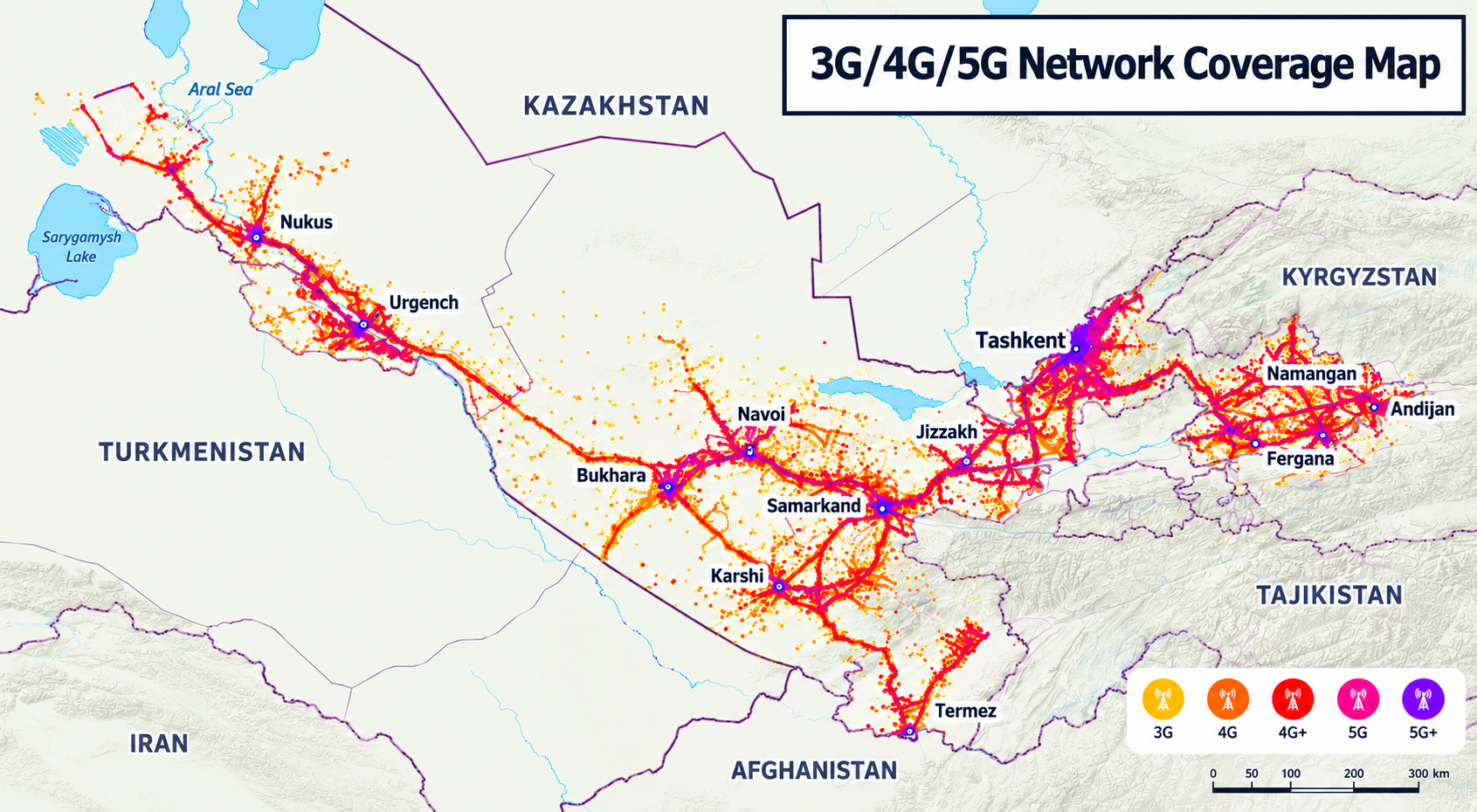
3G/4G/5G Network Coverage Map

4G accounts for 93–94% of traffic among the largest operators, while 5G has been launched in all regional centers, although coverage remains uneven.

Ucell serves more than 11 million subscribers, Uzmobile around 9.2 million, Mobiuz more than 8 million, and Beeline 7.7 million, with an EBITDA margin of 37.5%.

By 2030, Uzbekistan’s AI strategy envisages $1.5 billion in AI products and services.

The main gap is the absence of a unified assessment of the contribution of mobile technologies to GDP, employment, tax revenues, and productivity.

Feruz Rakhimov

CERR

Share this post

Similar news