According to a survey conducted by the National Statistics Committee in cooperation with the World Bank, the poverty rate in Uzbekistan in 2025 amounted to 5.8%, which is 3.1 percentage points lower compared to the previous year.
The methodology for assessing poverty in Uzbekistan is based on World Bank recommendations and relies on a household budget survey covering 16,000 households.
Poverty level in Uzbekistan
In 2023, the poverty rate in the country decreased from 14% to 11%, in 2024 to 8.9%, and in 2025 to 5.8%. As a result, 302 thousand families were lifted out of poverty this year.
A decline in poverty has been recorded across all regions of the country.
The most significant reductions in poverty were observed in Jizzakh region (from 11.8% to 5.8%), Khorezm region (from 11.9% to 6.7%), Syrdarya region (from 11.3% to 6.2%), the Republic of Karakalpakstan (from 10.8% to 6.6%), as well as in the city of Tashkent (from 7.3% to 3.5%).
The decline was particularly pronounced in urban areas, where poverty fell to 5.2% (from 8.6% in 2024). In rural areas, the indicator fell to 6.4% (from 9.2%). According to estimates, the number of people currently living below the poverty line stands at 2.2 million. Regionally, the largest number of poor residents is recorded in Samarkand region (265,000 people), as well as in Fergana (239,000), Kashkadarya (238,000), and Andijan (214,000) regions.
Structure of household incomes
Analysis of household income composition shows positive changes. The main income sources remain labor income, social benefits, pensions, and agricultural income.
According to available data, the average monthly per capita income amounted to 2.6 million soums. The income structure demonstrates that labor income remains the key source, accounting for 72.6%, notably higher than in the previous year (67.7%). The next largest share consists of old-age pensions – 11.8% (12.2% previously), followed by agricultural income – 10.1% (12.7%), social assistance – 1.6% (2.2%), and other income – 3.9% (5.2%).
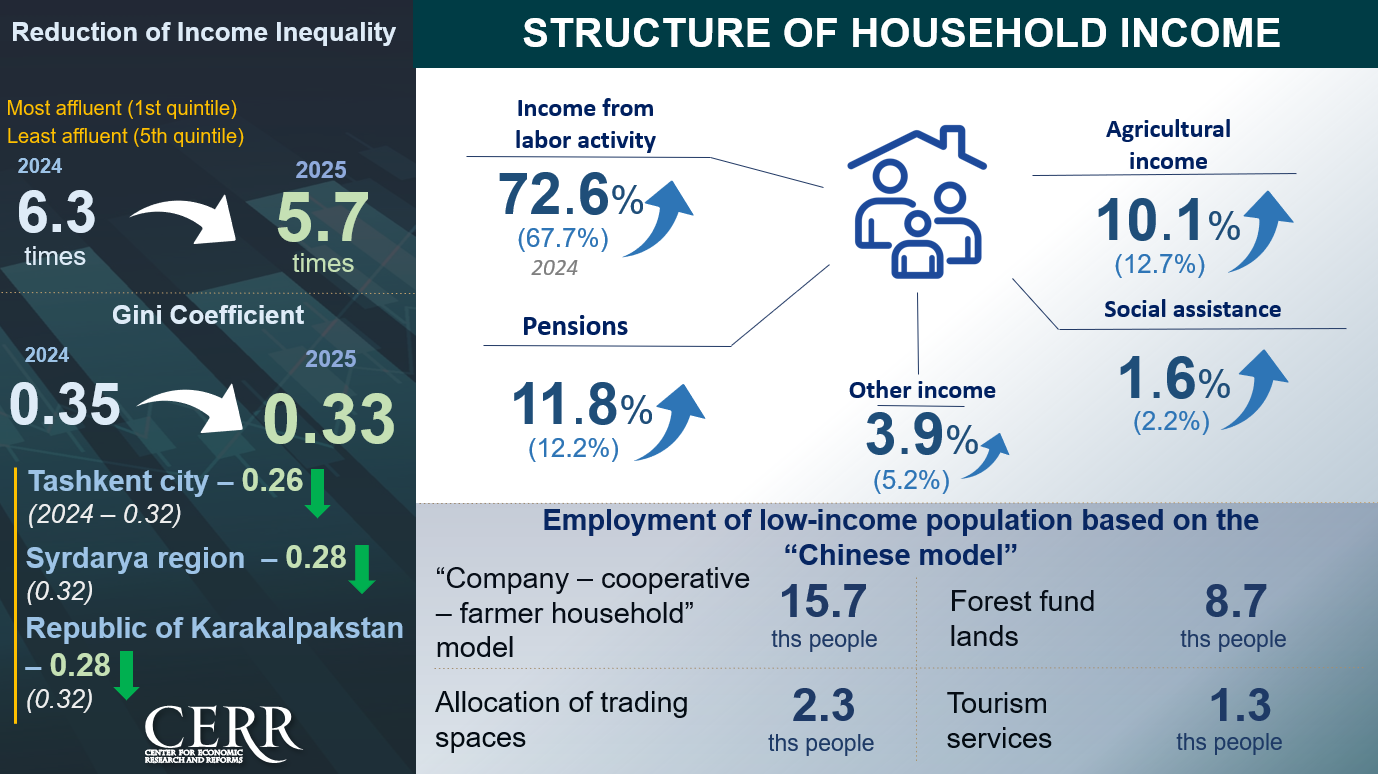
Overall, there is a decline in household dependence on transfers and an increasing role of employment income.
An important factor in creating high-income jobs and reducing poverty was the introduction of new approaches based on international experience, including the “Chinese model” approach (PP-12 of January 17, 2025). The adopted measures aim to expand economic opportunities for vulnerable groups, increase their engagement in entrepreneurial and production activities, and create sustainable income sources at the local level.
In particular, this year 484 cooperatives were established with the participation of export-oriented enterprises under the “Company – Cooperative – Farmer household” model, engaging 15.7 thousand members of low-income families. At the same time, 21 thousand hectares of forest fund land were allocated on lease to 8.7 thousand low-income families for cultivating medicinal plants. For 2.3 thousand families selling their own products, 7.5 thousand square meters of specialized trading space were provided at dehkan markets and supermarkets. Additional employment opportunities were created through the establishment of 12 “tourism mahallas” and the development of tourism services in 40 mahallas, which helped employ 1.3 thousand members of low-income families.
Furthermore, as part of the “Saikhunabad experience”, more than 394 thousand micro-projects worth a total of 18 trillion soums were implemented in mahallas, ensuring employment for 809 thousand people across the country.
Financial support for entrepreneurial activity was also significantly expanded. Over the eleven months of 2025, about 127.1 trillion soums in credit resources were allocated to support entrepreneurial initiatives. Of this amount, 27.7 trillion soums were provided under entrepreneurship support programs, including 13 trillion soums under the “Mahalla Project” (“Mahalla Loyihasi”), 6.6 trillion soums to support small businesses, 4.4 trillion soums under the “First Step into Business” program, and another 4 trillion soums under the “Family Entrepreneurship” program.
Income inequality
As a result of ongoing social policy measures, there has been a noticeable reduction in income inequality. In particular, the income gap between the highest-income group (1st quintile) and the lowest-income group (5th quintile) decreased from 6.3 times in 2024 to 5.7 times.
The positive dynamics are driven by faster income growth among vulnerable population groups. According to estimates, the income of the least affluent groups increased by 26%, while the income of the wealthiest segment grew by 13%.
The decline in inequality is reflected in the reduction of the Gini coefficient from 0.35 to 0.33. The most notable improvement was recorded in Tashkent, where the Gini coefficient decreased to 0.26 (from 0.32 a year earlier), as well as in Syrdarya region and the Republic of Karakalpakstan – to 0.28 (from 0.32).
Poverty assessment in Uzbekistan has been conducted regularly since 2020 and serves as a key source of data on living standards and household well-being, as well as the official basis for calculating monetary poverty.
CERR Public Relations Service



leave a comment