The Center for Economic Research and Reforms (CERR) has released updated bank rankings based on the Banking Activity Index for the third quarter of 2026.
The study covers 34 commercial banks operating in Uzbekistan. To ensure comparability, 20 banks were classified as large banks and 14 as small banks.
The Index is calculated using 27 sub-indicators grouped into seven dimensions, including financial intermediation and accessibility, capital adequacy, asset quality, management efficiency, profitability, and liquidity.
The indicators are assessed against banking system averages and applicable international standards, including the requirements of the Basel Committee on Banking Supervision. The Index also incorporates international approaches to assessing banks' financial stability.
Banking Activity Ranking of Large Banks
In the third quarter of 2026, 10 out of 20 large banks changed their positions in the overall Banking Activity Ranking. Ten banks maintained their positions, five improved their rankings, and five moved down.
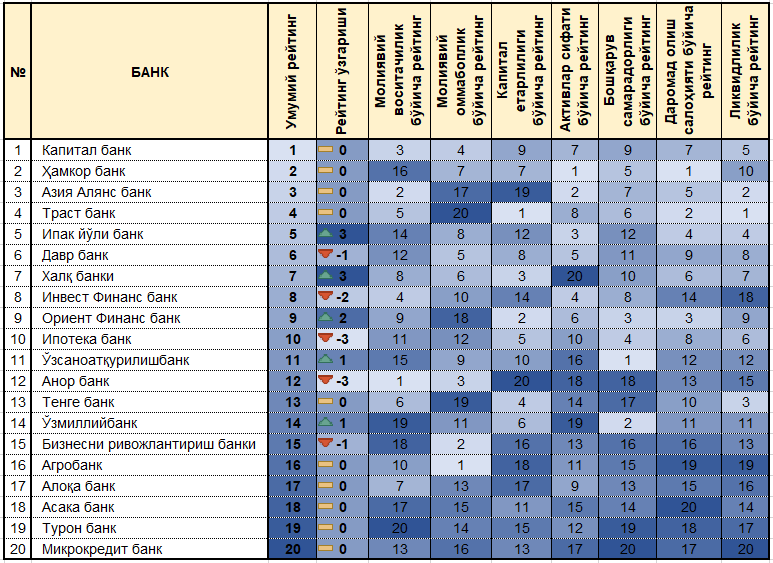
The top four positions remained unchanged. Kapitalbank, Hamkorbank, Asia Alliance Bank, and Trustbank retained their leading positions. Meanwhile, Ipak Yuli Bank climbed three places to enter the top five.
The largest improvements were recorded by Ipak Yuli Bank and People's Bank, each moving up three positions. The most notable declines were registered by Ipoteka Bank and Anorbank, both dropping three places.
Main Changes Across Index Components
In the third quarter of 2026, the strongest positive dynamics were observed in financial accessibility and financial intermediation. Meanwhile, in capital adequacy and asset quality, the number of banks that lost positions exceeded the number that improved. Management efficiency and profitability potential remained the most stable components.
Financial accessibility. Nine large banks improved their positions, five moved down, and six remained unchanged. Asia Alliance Bank recorded the largest improvement, climbing three places. The National Bank of Uzbekistan and Asakabank each advanced two positions. The most significant decline was recorded by Tenge Bank, which fell seven places.
Financial intermediation. Seven banks improved their positions, six declined, and seven remained unchanged. Microcreditbank recorded the largest increase, moving up five places. Ipak Yuli Bank climbed three positions, while Davrbank advanced two. Turonbank registered the largest decline, falling eight places.
Asset quality. Six banks improved their positions, eight declined, and six remained unchanged. Trustbank recorded the largest improvement, advancing five positions, followed by Asakabank with a three-place increase. The Business Development Bank registered the largest decline, dropping three positions. Uzpromstroybank and Aloqabank each lost two places.
Capital adequacy. Six banks improved their positions, eight declined, and six maintained their rankings. Tenge Bank recorded the largest improvement, climbing ten positions. Turonbank advanced three places. Meanwhile, Ipak Yuli Bank, Microcreditbank, and the Business Development Bank each dropped four positions.
Management efficiency. Three banks improved their positions, four declined, and 13 remained unchanged. Kapitalbank recorded the largest improvement, moving up two places. The National Bank of Uzbekistan and Asakabank each advanced one position. Orient Finans Bank, People's Bank, Davrbank, and Agrobank each dropped one place.
Profitability. Two banks improved their positions, four declined, and 14 remained unchanged. People's Bank and Turonbank each climbed two positions. Meanwhile, Kapitalbank, Ipoteka Bank, Asakabank, and Agrobank each lost one place.
Liquidity. Six banks improved their positions, seven declined, and seven remained unchanged. Asakabank recorded the largest improvement, climbing four positions. Trustbank, the National Bank of Uzbekistan, Davrbank, and the Business Development Bank each advanced two places. The most notable declines were recorded by Infinbank, which dropped four positions, and Anorbank, which fell three places.
Transformation Trends
The ranking results indicate improvements among several banks in financial accessibility and financial intermediation. At the same time, differences remain in loan portfolio quality, liquidity, and management efficiency.
Expanding access to loans and other financial services for households and businesses, alongside improvements in loan portfolio quality and risk management, will contribute to strengthening banks' financial stability.
Banking Activity Ranking of Small Banks
In the third quarter of 2026, 10 out of 14 small banks changed their positions in the overall ranking. Five banks improved their rankings, five moved down, and four maintained their previous positions.
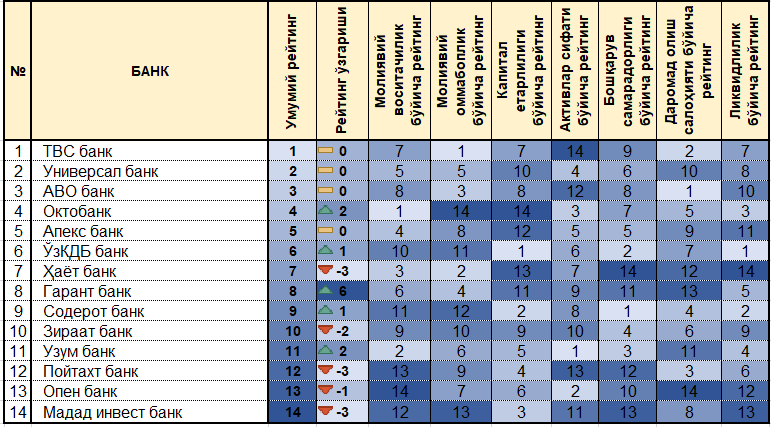
The top three positions remained unchanged, with TBC Bank, Universal Bank, and AVO Bank retaining their leading positions.
Garant Bank recorded the largest improvement, climbing six places from 14th to 8th position. Hayot Bank, Madad Invest Bank, and Poytaxtbank each dropped three positions.
Main Changes Across Index Components
The most notable changes were observed in financial intermediation, capital adequacy, and asset quality. Further improvements in banks' rankings will depend on loan portfolio quality, risk management, and the stability of financial performance.
Jafar Khidirov
Center for Economic Research and Reforms (CERR)
Banking and Financial Sector Research Division
Tel.: +998 (78) 150 02 02 (ext. 441)
Public Relations and Media Relations Division
Tel.: +998 (78) 150 02 02 (ext. 417)








leave a comment