
Infographic: Socio-Economic Development Indicators of Bukhara Region, 2017–2025
CERR has prepared an overview and infographic on the dynamics of socio-economic development in Bukhara Region in 2017–2025.

Bukhara Region ranks second in Uzbekistan in terms of area, after Navoi Region. In recent years, large-scale construction and development projects have been implemented across the region. The number of major industrial enterprises has increased significantly, while new social facilities and multi-storey residential buildings have been constructed.
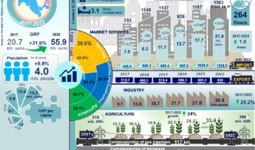
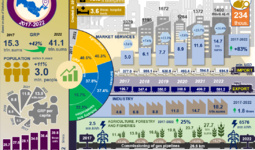
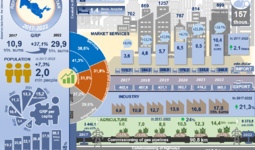
During 2017–2025, the Gross Regional Product (GRP) of Bukhara Region increased from 17.1 trillion sums to 86.6 trillion sums, representing 47.4% growth in real terms. GRP per capita rose from 10.5 million sums to 41.4 million sums. Over the same period, the region's population grew by 12.6%, reaching 2.1 million people.
As a result of the effective utilization of industrial potential and the establishment of modern production facilities, industrial output increased from 6.4 trillion sums to 53.5 trillion sums, representing 36.7% growth in real terms. This contributed significantly to the region's economic development. Consequently, the share of industry and construction in GRP increased from 21.6% to 31.1%.
Measures aimed at meeting growing demand for modern and household services contributed to an increase in market services from 8.1 trillion sums to 42.7 trillion sums, representing 88% growth in real terms.
As a result of agricultural reforms and the creation of a favorable agribusiness environment, agricultural output increased by 32% in real terms, reaching 48.3 trillion sums.
Trade liberalization and measures to support and stimulate entrepreneurial export activities contributed to a 53% increase in regional exports over the nine-year period, bringing their value to $414 million.
During this period, measures aimed at further improving the business environment and supporting entrepreneurship enabled the implementation of investment projects worth $20 billion. As a result, the number of operating enterprises reached 25,100, and approximately 278,000 new jobs were created.
To improve living conditions, the region commissioned 7,100 km of roads, 404.6 km of gas pipelines, and 2,350 km of drinking water supply networks over the nine-year period.
Particular attention was paid to developing new social infrastructure. The region commissioned 10.1 million square meters of housing and created 19,100 places in preschools, 42,000 additional places in schools, and 16,000 hospital beds.
Golibjon Tursunkulov, CERR




leave a comment