In 2025, mobile technologies contributed $1.5 trillion to China’s economy, equivalent to 7.2% of GDP. By 2030, their contribution is projected to reach $2.11 trillion, or 8.4% of GDP.
China accounts for more than 40% of global 5G connections, and by 2030 the number of 5G connections in the country is expected to exceed 1.7 billion. Further growth will be driven primarily by the adoption of 5G-Advanced, mobile AI, edge computing, satellite networks, and 6G. At the same time, 94% of the economic impact is generated outside the telecommunications sector, including manufacturing, services, construction, agriculture, finance, and public administration.
Macroeconomic Context
In 2025, China’s economy grew by 4.7%, compared with 3.1% globally, although growth slowed noticeably compared with 2021.
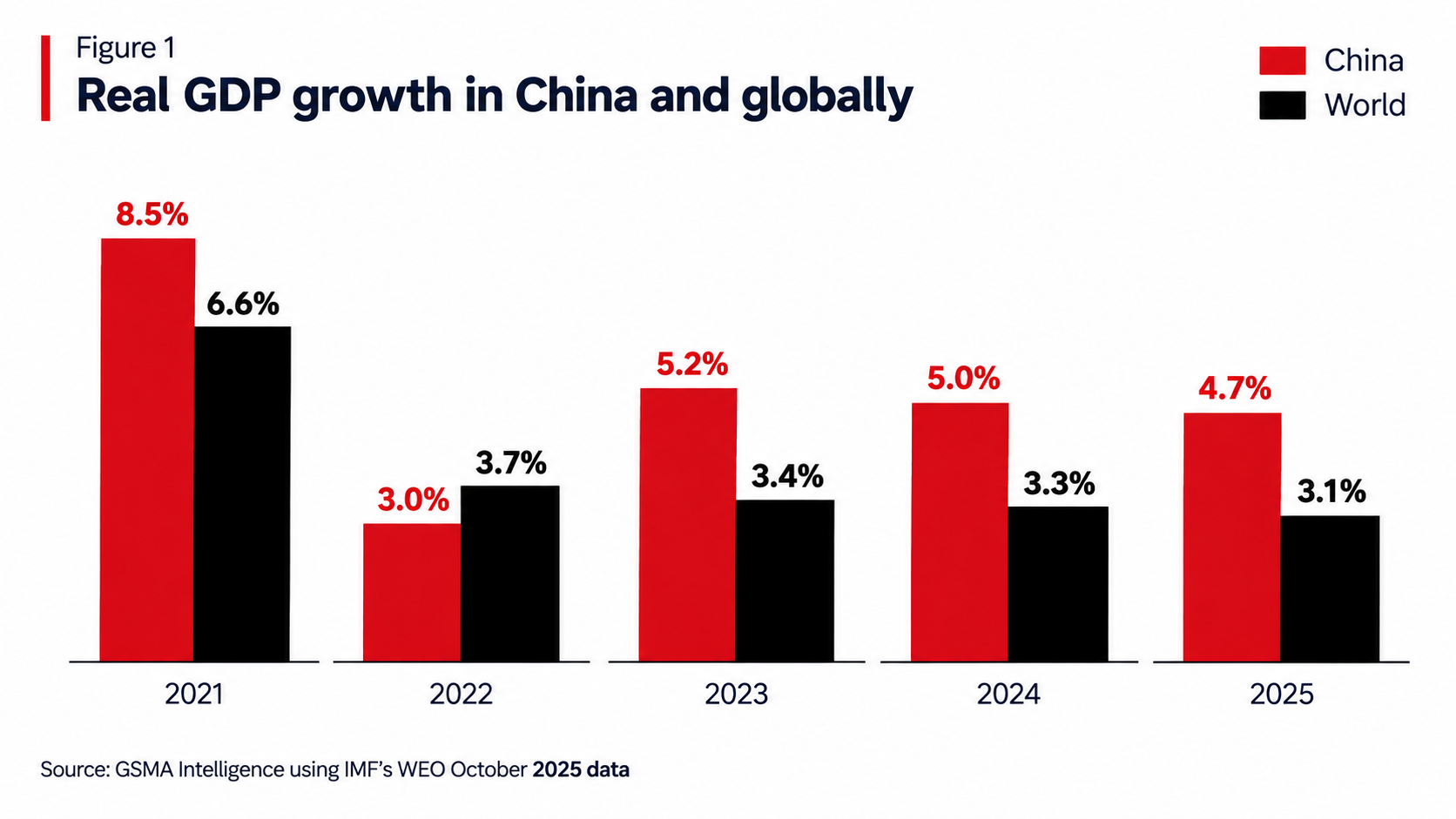
The main reasons are weak domestic demand, the real estate crisis, the debt burden of local governments, and subdued investment activity.
In 2026–2030, China is focusing on domestic demand, technological self-reliance, advanced manufacturing, semiconductors, artificial intelligence, and computing infrastructure. The contribution of mobile technologies to the economy is expected to increase from $1.5 trillion to $2.11 trillion, while their share of GDP will rise from 7.2% to 8.4%, reflecting a shift from expanding connectivity to improving economic productivity.
Digital Connectivity and the 5G Market
In 2024, internet coverage reached 91% of China’s population. While the coverage gap stood at around 1%, the usage gap remained at 8%, indicating a shift in priorities from network deployment toward developing digital skills, stimulating demand, and expanding the practical use of online services.
The share of 5G connections is expected to rise from 65% in 2025 to 88% by 2030. In mainland China, the number of 5G connections will reach around 1.7 billion, accounting for nearly one-third of the global total. The decline in China’s global share will reflect faster 5G adoption in other regions rather than a weakening of the domestic market.
Operator Revenues, Investment and Employment
Revenues of China’s mobile operators are projected to increase from $191 billion in 2025 to $222.8 billion in 2030, an increase of 16.6%. Capital expenditure over the five-year period will amount to $194.1 billion. Operator revenues are expected to grow by an average of 3.1% per year, while the overall economic impact of mobile technologies will grow by 7%, indicating that most of the value added will be generated outside the telecommunications sector.
At the beginning of 2025, 30.1 million people used mobile services, equivalent to 81 mobile subscribers per 100 inhabitants, while there were 109 active internet subscriptions per 100 inhabitants.
In 2025, GDP grew by 7.7% to UZS 1,849.7 trillion, telecommunications services increased by 8.6% to UZS 22.6 trillion, while communications and information services expanded by 22.7% to UZS 79.5 trillion.
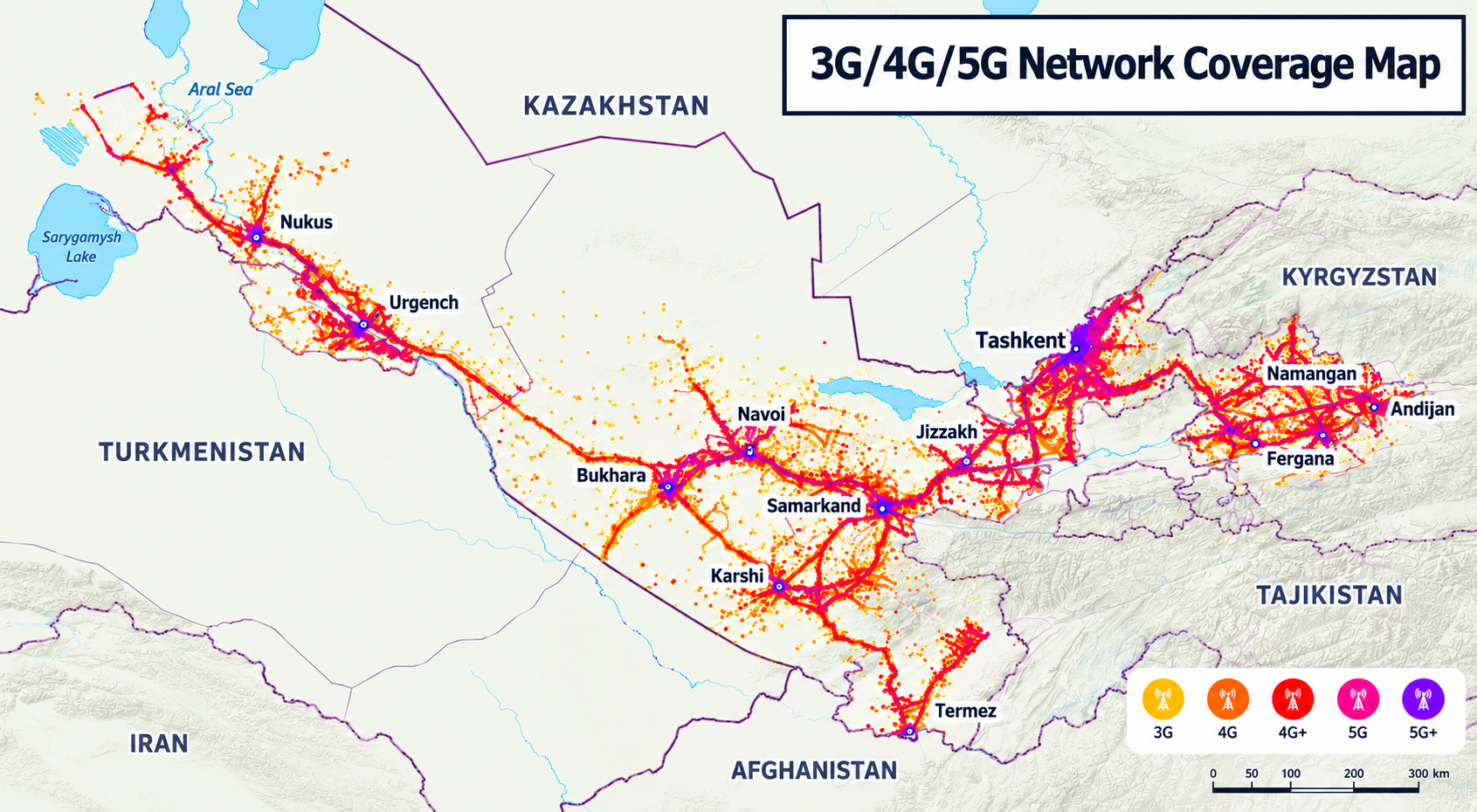
3G/4G/5G Network Coverage Map
4G accounts for 93–94% of traffic among the largest operators, while 5G has been launched in all regional centers, although coverage remains uneven.
Ucell serves more than 11 million subscribers, Uzmobile around 9.2 million, Mobiuz more than 8 million, and Beeline 7.7 million, with an EBITDA margin of 37.5%.
By 2030, Uzbekistan’s AI strategy envisages $1.5 billion in AI products and services.
The main gap is the absence of a unified assessment of the contribution of mobile technologies to GDP, employment, tax revenues, and productivity.
Feruz Rakhimov
CERR






leave a comment