At the invitation of President Serdar Berdimuhamedov of Turkmenistan, President Shavkat Mirziyoyev will pay a working visit to Turkmenistan on October 7-9.
In the Avaza National Tourist Zone, the President of Uzbekistan will participate in the eighth Consultative Meeting of the Heads of State of Central Asia and Azerbaijan, as well as the regular summit of the Commonwealth of Independent States.
Ahead of the upcoming visit, CERR has prepared a series of informational and analytical materials on the current state and prospects of regional cooperation.
Over the past nine years, the main indicators of Uzbekistan’s trade and economic cooperation with Central Asian countries have increased substantially.
Between 2017 and 2025, Uzbekistan’s trade turnover with Central Asian countries increased 3.1-fold to $8.3 billion. Exports rose 2.1-fold to $3.1 billion, while imports increased 4.2-fold to $5.1 billion.
The number of enterprises with investment from Central Asian countries increased more than sevenfold, reaching over 2,300.
The annual volume of foreign direct investment and loans attracted to Uzbekistan from Central Asian countries increased more than 600-fold, reaching $1.3 billion in 2025, compared with only $2.1 million in 2017.
In the structure of mutual trade in 2025, Kazakhstan remained the largest partner, with trade turnover reaching $5 billion, or 60.2% of Uzbekistan’s total trade with the countries of the region. Trade turnover with Turkmenistan reached $1.2 billion, or 14.5%, while trade with Kyrgyzstan also amounted to $1.2 billion, or 14.5%. Trade turnover with Tajikistan totaled $912.3 million, or 11%.
Uzbekistan’s exports to Central Asian countries reached $3.2 billion in 2025. The region accounted for 9.8% of Uzbekistan’s total exports. Imports from Central Asian countries stood at $5.1 billion, with their share in the country’s total imports reaching 11.1%.
Potential for Expanding Mutual Trade
Mutual trade among Central Asian countries is conducted under a free trade regime based on bilateral free trade agreements signed in 1996–1997.
According to CERR estimates, replacing imports from third countries with reciprocal export supplies could increase intraregional trade by $11.4 billion.
The potential for expanding intraregional trade is therefore very high. To realize this potential, both tariff barriers, including exemptions, and non-tariff barriers in mutual trade need to be eliminated. It is also necessary to create conditions that provide exporters and importers in the region with regular access to information on supply and demand within the common Central Asian market.
Investment Cooperation
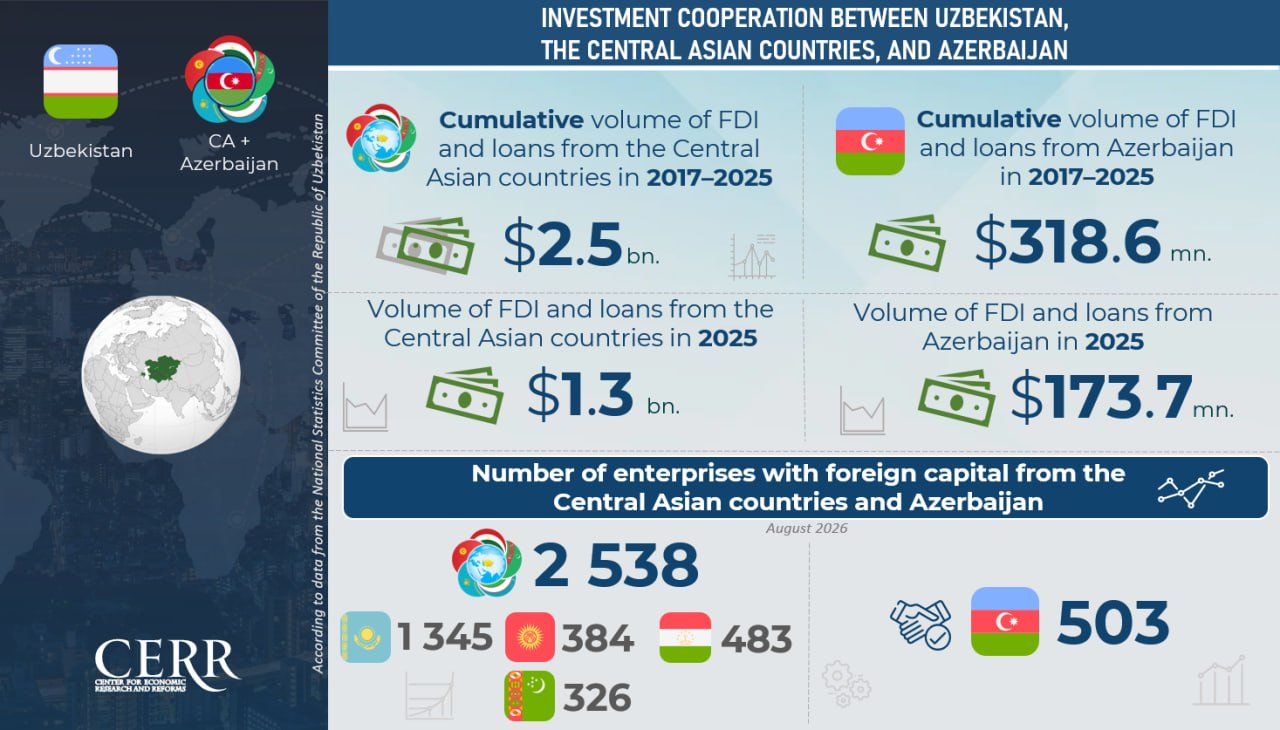
Investment cooperation is developing alongside trade. The total volume of foreign direct investment and loans from Central Asian countries amounted to $2.5 billion in 2017–2025. In 2025 alone, direct investment and loans attracted from the region reached $1.3 billion.
As of June 2026, 2,384 enterprises with capital from Central Asian countries were operating in Uzbekistan. The largest number of enterprises, 1,283, were established with Kazakh capital. There were 442 enterprises with Tajik capital, 362 with Kyrgyz capital, and 297 with Turkmen capital.
Mutual Trade with Azerbaijan
Cooperation between Uzbekistan and Azerbaijan has intensified noticeably in recent years and has reached the highest level of interstate interaction: strategic partnership and allied relations.
The Supreme Interstate Council, chaired by the Presidents of the two countries, has been established and has become an effective mechanism for advancing multifaceted cooperation between Uzbekistan and Azerbaijan.
Mutual trade between Uzbekistan and Azerbaijan is conducted under a free trade regime.
Between 2017 and 2025, Uzbekistan’s trade turnover with Azerbaijan increased 9.5-fold, from $32.5 million to $307.3 million. Exports increased 8.2-fold, from $27.6 million to $227.3 million, while imports rose 16.3-fold, from $4.9 million to $80 million.
In 2025, the structure of Uzbekistan’s exports to and imports from Azerbaijan consisted of the following commodity groups.
Total exports amounted to $227.3 million, including manufactured goods at $63.4 million, or 28% of exports; machinery and transport equipment at $49.3 million, or 22%; food products at $36.3 million, or 16%; beverages and tobacco at $34.3 million, or 15%; miscellaneous manufactured articles at $11 million, or 5%; chemical products at $5.1 million, or 2.2%; and services at $22.5 million, or 10%.
Total imports amounted to $80 million, including food products at $43.2 million, or 54% of imports; manufactured goods at $17.4 million, or 22%; machinery and transport equipment at $5.8 million, or 7.3%; chemical products at $5.4 million, or 6.8%; non-food raw materials at $1.3 million, or 1.6%; mineral fuels and lubricating oils at $1.2 million, or 1.5%; and services at $4.3 million, or 5.4%.
Investment Cooperation
Particular attention is being paid to investment cooperation. In 2023, the Azerbaijan-Uzbekistan Investment Company was established with authorized capital of $500 million.
Currently, 460 enterprises with Azerbaijani capital are operating in Uzbekistan. Compared with 2017, when there were 71 such enterprises, their number has increased 6.5-fold.
In 2025, the volume of Azerbaijani investment in Uzbekistan amounted to $173.7 million, compared with $0.1 million in 2017. The cumulative volume of Azerbaijani investment in Uzbekistan reached $318.6 million.
The main areas of activity of enterprises with Azerbaijani capital are construction, manufacturing, and agriculture.
Uzbek capital is also expanding its presence in the Azerbaijani market. In particular, joint ventures have been established to manufacture automobiles and textile products.
Transport is an important area of cooperation. Uzbekistan is interested in implementing joint projects aimed at making effective use of Azerbaijan’s transport and logistics infrastructure to deliver goods to Europe via the Trans-Caspian International Transport Route, also known as the Middle Corridor.
CERR Public Relations Sector



leave a comment