The Center for Economic Research and Reforms (CERR) presented the results of its analysis of Uzbekistan’s business climate, based on monthly nationwide surveys of entrepreneurs.
Based on the data collected, a composite business climate indicator has been developed, reflecting assessments of current business conditions and expectations for the next 3 months.
Business Climate Dynamics in Uzbekistan
As of April, the composite Business Climate Index reached 60 points, increasing by 3 points year-on-year and by 4 points compared to March. The indicator remains in positive territory (above 50 points).
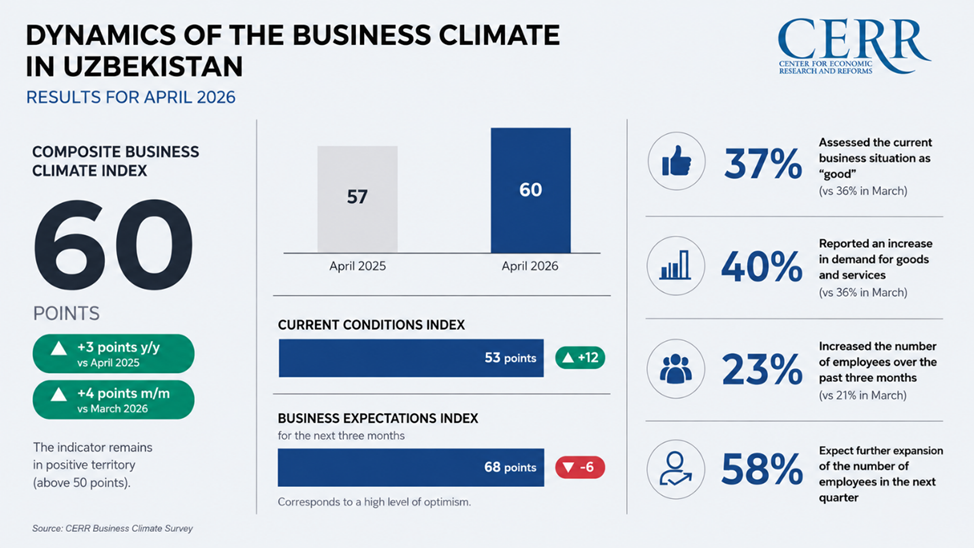
The overall dynamics was driven by improved assessments of current conditions alongside a slight decline in expectations. The Current Conditions Index reached 53 points, which is 12 points higher than in April of the previous year. The Expectations Index for the next 3 months declined by 6 points to 68 points, still indicating a high level of optimism.
Survey results point to positive trends in key business activity indicators. Over the past three months, 37% of entrepreneurs assessed business conditions as “good” (36% in March). Demand for goods and services increased according to 40% of respondents, compared to 36% a month earlier.
Positive dynamics are also observed in employment. The share of enterprises that increased their workforce over the past three months reached 23% (21% in March). A further expansion of employment in the coming quarter is expected by 58% of enterprises.
Sectoral Dynamics of the Business Climate Index
Across all major sectors, business climate conditions improved compared to the previous year.
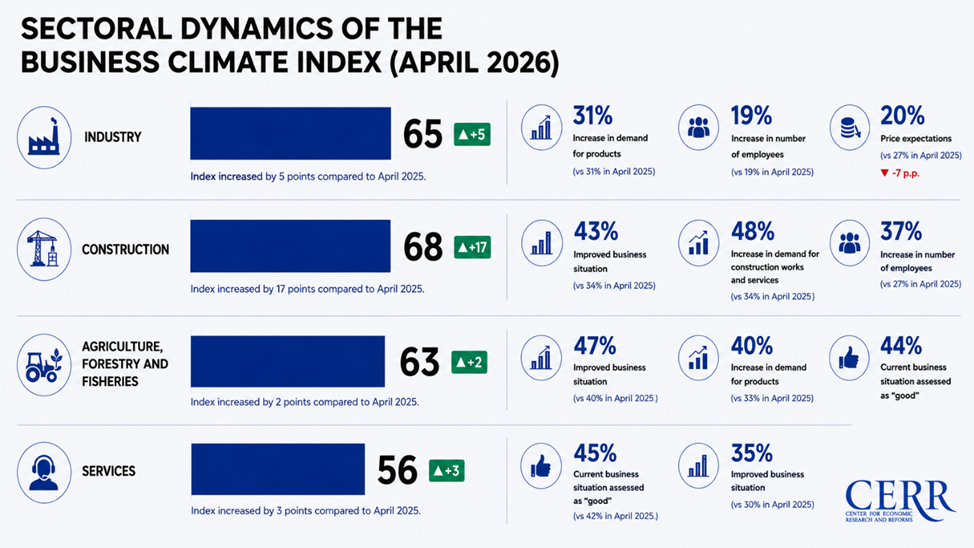
In industry, the index increased by 5 points year-on-year to 65 points. Demand and employment indicators remained stable compared to last year: 31% of entrepreneurs reported increased demand (unchanged from April 2025), while 19% reported workforce growth, also in line with the previous year. Price expectations in industry declined by 7 percentage points to 20%.
In construction, the index rose by 17 points year-on-year to 68 points. This improvement was accompanied by stronger operational performance across the sector. Over the past three months, 43% of entrepreneurs reported improved business conditions (34% a year earlier). Demand for construction works and services increased for 48% of respondents, which is 14 percentage points higher than in April of the previous year. Employment expanded in 37% of surveyed enterprises (27% a year earlier).
In agriculture, the index increased by 2 points year-on-year to 63 points. Over the past three months, 47% of entrepreneurs reported improved conditions (40% a year earlier). Demand for agricultural products increased according to 40% of respondents, which is 7 percentage points higher than the previous year. Meanwhile, 44% of respondents assessed current conditions as “good.”
In the services sector, the index showed moderate growth, reaching 56 points. Current business conditions were assessed as “good” by 45% of entrepreneurs (42% a year earlier). Improvement over the past three months was noted by 35% of respondents.
Barriers to Entrepreneurial Activity
Survey results indicate a decline in the number of entrepreneurs facing barriers. The share of respondents reporting no obstacles increased to 60%, compared to 52% in March. The lowest level of difficulties was observed in agriculture and services, where 65% and 61% of respondents respectively reported no barriers.
Compared to the previous month, fewer respondents reported difficulties related to access to credit, electricity supply, and transport and logistics. At the same time, there was a moderate increase in mentions of issues related to access to land, utility costs, and tax rates.
At the sectoral level, the structure of barriers shows distinct characteristics. In agriculture, mentions related to water supply increased by 8 percentage points to 15%, and utility costs also rose by 8 percentage points to 11%.
In industry and construction, barriers related to tax administration increased by 6 percentage points, reaching 13% and 17% respectively.
At the same time, several sectors reported a decline in financial constraints. In industry, difficulties in accessing credit decreased by 2 percentage points to 9%. In services, mentions of tax administration and other financial difficulties declined by 1 percentage point, reaching 13% and 7% respectively.
CERR Sector for Competitiveness Studies and Investment Activity
tel: +998 (78) 150-02-02 (441)
CERR Public Relations and Media Sector
tel: +998 (78) 150-02-02 (417)



leave a comment