
Uzbekistan’s Export Performance in Q1 2026
At the end of Q1 2026, the republic’s exports of goods and services demonstrated a steady growth trend.

During the reporting period, exports totaled $5.8 bn, increasing by 26%, or $1.2 bn, compared to the same period last year.
Export growth was driven primarily by the expansion of shipments of higher value-added products and raw materials. In particular, exports of natural uranium amounted to $402.6 mn, increasing by $196 mn, or 95%. Exports of non-ferrous metals reached $248.7 mn, up by $137 mn, with a twofold increase recorded. Exports of oil and gas products totaled $160 mn, rising by $20 mn, or 15%.
Positive dynamics were also observed in manufacturing industries. Textile exports reached $731 mn, increasing by $110 mn, or 18%. Exports of construction materials totaled $304 mn, up by $130 mn, or 75%. Exports of jewelry products reached $214 mn, increasing by $75 mn, or 54%.
Sustained growth was also recorded in agricultural and food exports. Fruit and vegetable exports reached $320 mn, increasing by $34 mn, or 12%. Food product exports totaled $282 mn, increasing by $47 mn, or 120%.
Strong growth was also achieved in services. During the reporting period, services exports amounted to $2.2 bn, increasing by 35%, or $573 mn, compared to last year.
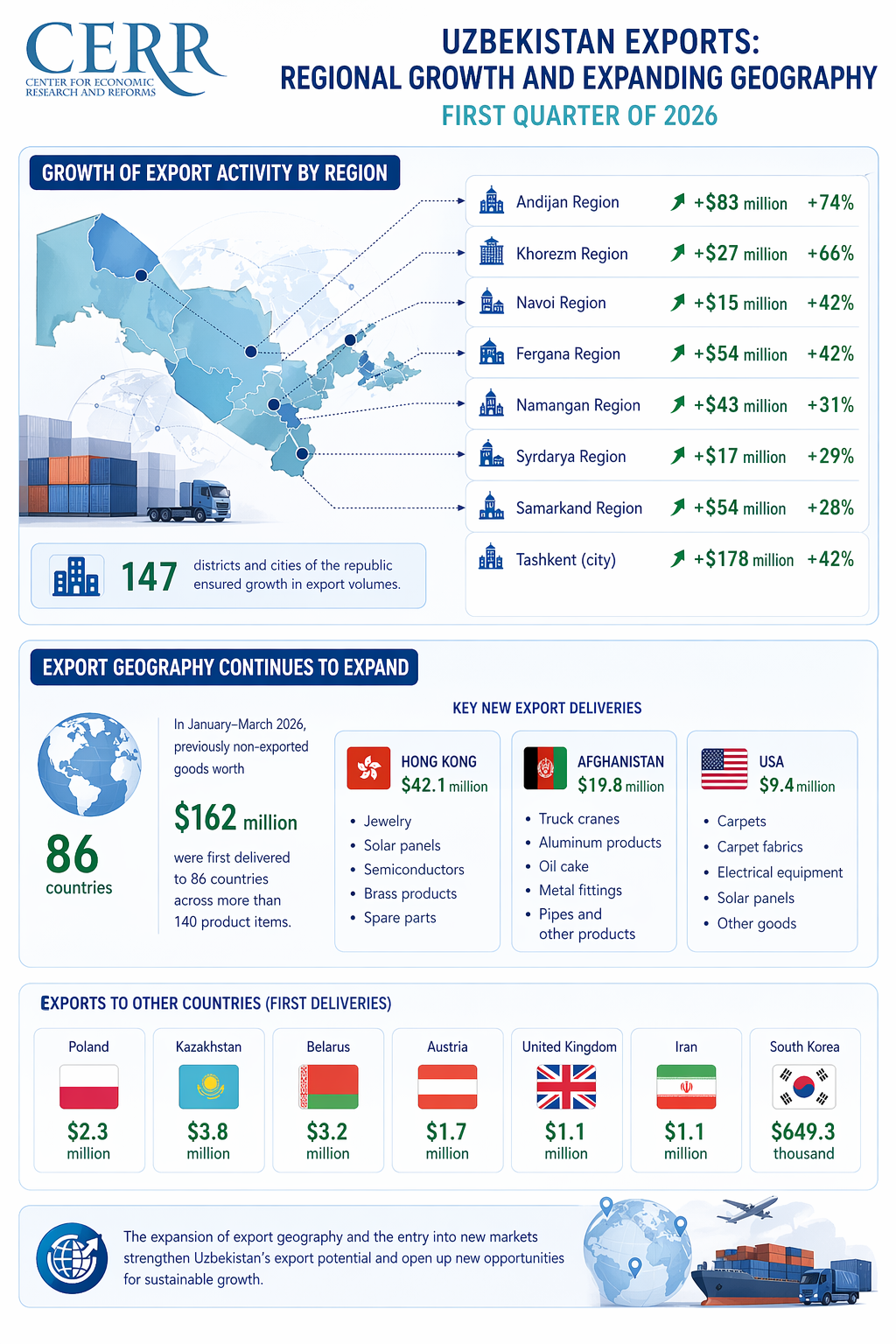
Regional export activity also expanded. In Andijan region, exports increased by $83 mn, or 74%; in Khorezm region by $27 mn, or 66%; in Navoi region by $15 mn, or 42%; in Fergana region by $54 mn, or 42%; in Namangan region by $43 mn, or 31%; in Syrdarya region by $17 mn, or 29%; and in Samarkand region by $54 mn, or 28%. In Tashkent city, exports grew by $178 mn, or 42%.
Export growth was recorded in 147 districts and cities across the republic.
The geography of exports continues to expand. In January–March of the current year, previously non-exported goods worth $162 mn across more than 140 product categories were supplied for the first time to 86 countries, including the United States, Austria, Belarus, Poland, South Korea, Iran, Kazakhstan, and Afghanistan.
In particular, exports to Hong Kong included jewelry, solar panels, semiconductors, brass products, and spare parts worth $42.1 mn. Exports to Afghanistan included truck cranes, aluminum products, oilcake, metal fittings, pipes, and other goods worth $19.8 mn. Exports to the United States included carpets, rug fabrics, electrical equipment, solar panels, and other goods worth $9.4 mn.
In addition, exports amounted to $2.3 mn to Poland, $3.8 mn to Kazakhstan, $3.2 mn to Belarus, $1.7 mn to Austria, $1.1 mn to the United Kingdom, $1.1 mn to Iran, and $649.3 thousand to South Korea.
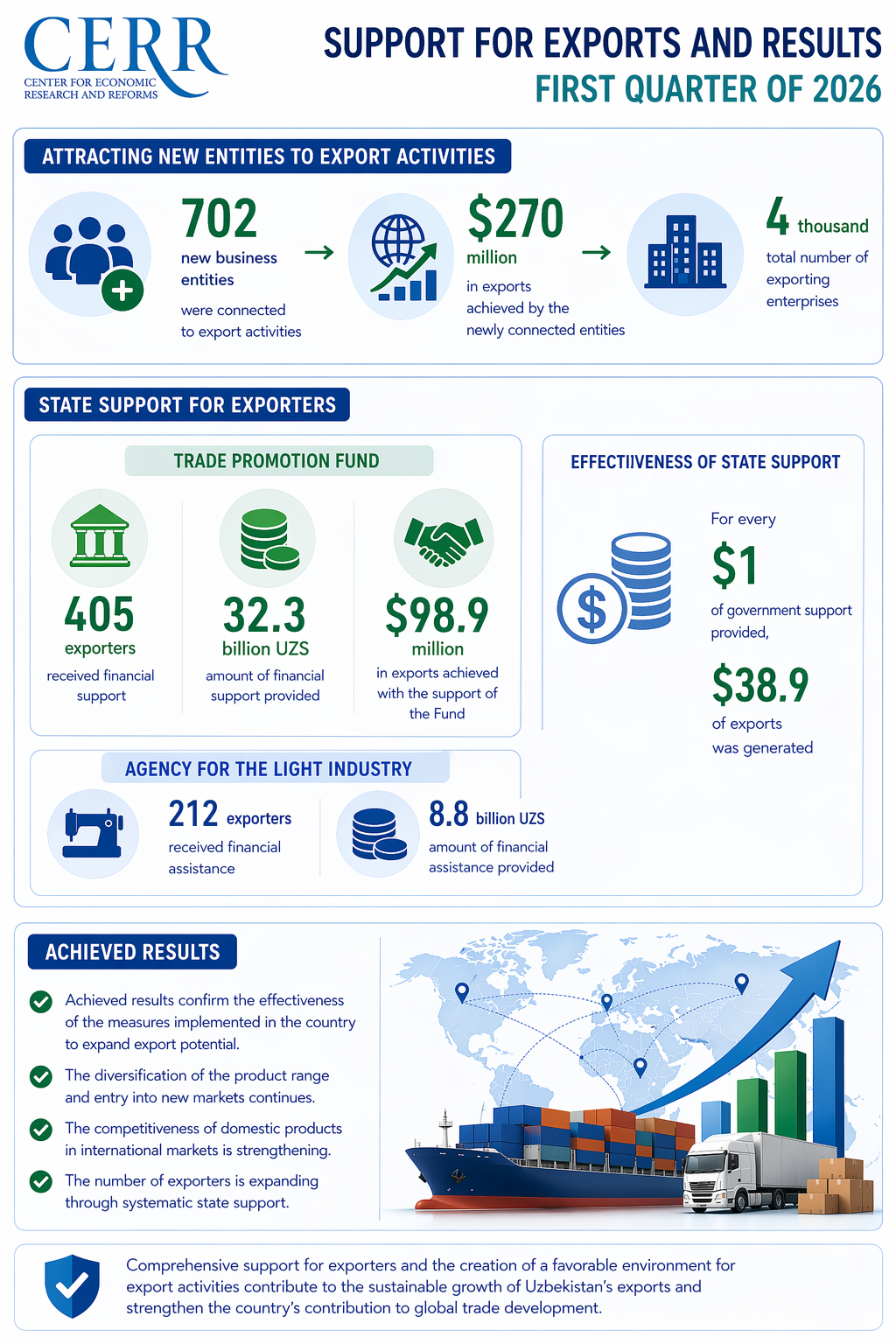
As a result of efforts to involve new businesses in export activity, 702 new business entities joined export operations during the reporting period. Their exports totaled $270 mn. As a result, the total number of exporting enterprises reached 4 thousand.
Within the national export support system, financial and organizational assistance to exporting enterprises continued. Through the Trade Promotion Fund, 405 exporters received financial support totaling 32.3 bn soums, while these companies exported goods worth $98.9 mn. Every $1 of state support generated $38.9 in exports.
In addition, the Light Industry Agency provided financial assistance totaling 8.8 bn soums to 212 exporters.
The achieved results confirm the effectiveness of the measures being implemented in the country to expand export potential, diversify the product range, and strengthen competitiveness in foreign markets.
Center for Economic Research and Reforms Media Sector


leave a comment