Business Development through the Open Dialogue
The Open Dialogue between the Head of State and entrepreneurs has become a key instrument for shaping modern economic policy aimed at supporting businesses and creating a favorable business environment. These meetings strengthen trust between the government and the private sector by providing a direct channel for discussing pressing issues and jointly developing solutions. Based on the outcomes of the dialogues, specific measures are adopted to simplify business operations, reduce administrative barriers, digitalize public services, and expand businesses’ access to financial resources.
Particular attention is paid not only to streamlining procedures and increasing transparency, but also to strengthening corporate social responsibility, promoting innovation, and supporting export-oriented projects. This comprehensive policy creates conditions for small businesses not only to establish sustainable positions in the domestic market but also to actively enter international markets.
In recent years, this approach has delivered tangible results: small businesses account for more than half of GDP, over one-third of exports, and a significant share of industrial production. In 2025, their contribution amounted to 52.2% of GDP, 36.6% of exports, and 28.5% of industrial production.
The steady dynamics of these indicators confirm that the entrepreneurial sector is becoming an important driver of economic diversification and is opening up new opportunities for expanding Uzbekistan’s foreign economic ties.
Overview of Entrepreneurial Activity in 2025
The past year reaffirmed the key role of small businesses in Uzbekistan’s economy. In 2025, their contribution amounted to 52.2% of GDP, 36.6% of exports, and 28.5% of industrial production. The highest shares of small businesses were recorded in trade — 83%, construction — 75.6%, and services — 47.2%.
These indicators demonstrate that entrepreneurial activity is one of the key factors driving economic growth and diversification.
According to the National Statistics Committee, 82.4 thousand new enterprises were established in the country during 2025, bringing the total number of operating enterprises to 493 thousand.
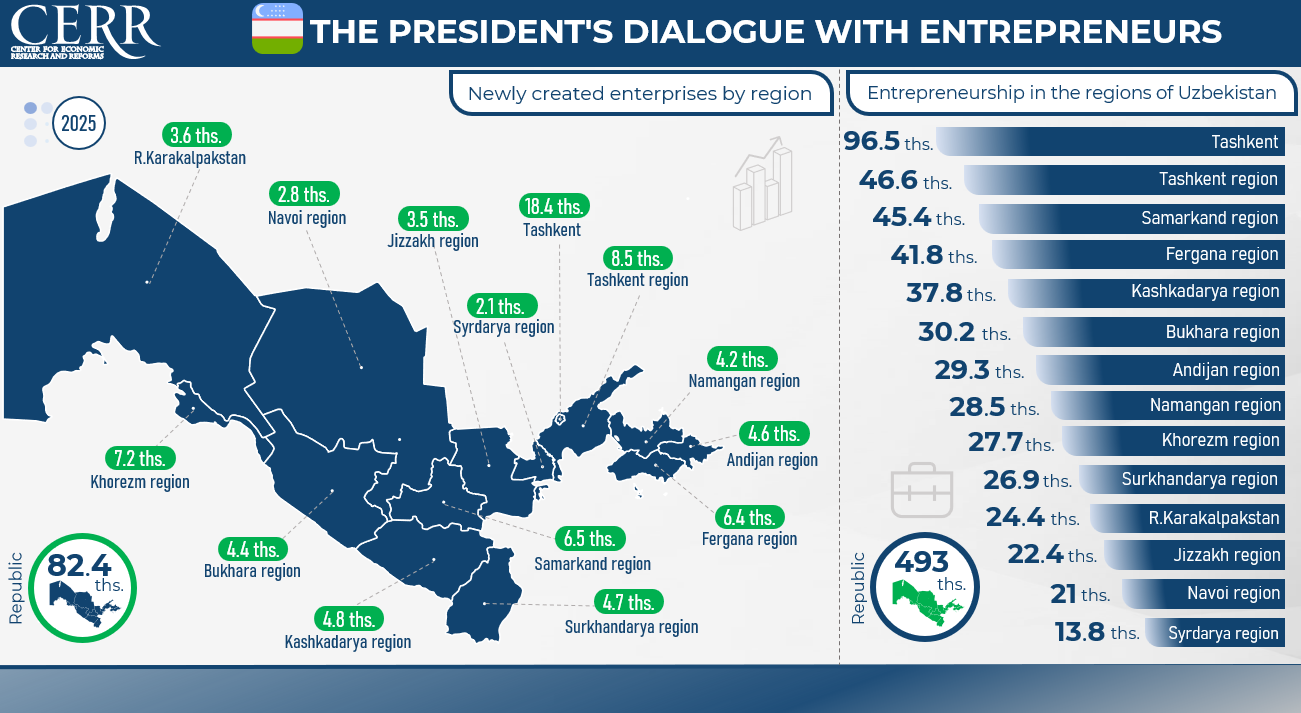
Trade led in terms of newly established businesses, with 30.2 thousand enterprises created.
A total of 9.9 thousand enterprises were registered in agriculture, 9.5 thousand in industry, and 7.2 thousand in accommodation and food services.
Another 4.5 thousand new enterprises were established in construction, 3.1 thousand in information and communications, 2.6 thousand in transportation and storage, and 1.8 thousand in healthcare.
Other types of economic activity accounted for 13.3 thousand new enterprises.
Regional dynamics also demonstrate a noticeable increase in business activity. The largest number of new enterprises was established in Tashkent city — 18.4 thousand, followed by Tashkent region — 8.5 thousand, Khorezm region — 7.2 thousand, Samarkand region — 6.5 thousand, and Fergana region — 6.4 thousand. In Kashkadarya, Surkhandarya, Andijan, Bukhara, and Namangan regions, between 4.2 thousand and 4.8 thousand new enterprises were registered.
Positive dynamics also continued in comparatively less active regions — the Republic of Karakalpakstan and Jizzakh, Navoi, and Syrdarya regions. This trend indicates that entrepreneurial activity is becoming increasingly widespread across the country.
In terms of the total number of operating enterprises by region, the largest concentration was recorded in Tashkent city — 96.5 thousand, accounting for almost one-fifth of all enterprises in the country. It was followed by Tashkent region — 46.6 thousand, Samarkand region — 45.4 thousand, Fergana region — 41.8 thousand, and Kashkadarya region — 37.8 thousand.
These figures confirm that small and medium-sized businesses in Uzbekistan not only remain one of the main drivers of the economy but are also becoming increasingly sustainable. The growing number of enterprises, their diversification across sectors and regions, and their active participation in exports are the result of ongoing reforms and efforts to liberalize the business environment.
Conclusion
The sixth Open Dialogue between the President and entrepreneurs in 2026 will serve as a platform for discussing pressing business challenges and developing new initiatives.
The focus will be on entrepreneurs’ proposals concerning foreign economic activity, taxation, infrastructure, financial support, protection of business rights, and access to new markets.
The event is expected to become another step toward further improving the business environment and building a competitive and sustainable economy.
CERR Public Relations Sector



leave a comment