Before turning to the main agenda, the Head of State highlighted the outcomes of the fifth Tashkent International Investment Forum, which was held last week at a high organizational level. It was noted that 177 agreements worth $43 billion were reached with foreign partners during the forum.
“Each agreement must be translated into a concrete project, new jobs, and products with high added value,” the President emphasized.
Officials were instructed to submit a draft resolution on the implementation of 120 proposals put forward by foreign investors. Sector leaders and regional khokims were also tasked with revising their approaches to ensuring the quality and efficiency of attracted investments.
It was noted that over the past five years, half of all investments attracted to the economy were concentrated in just four regions of the country. Significant disparities also remain among regions in terms of returns on invested capital. In this regard, khokims were instructed to use precise calculations to determine which sectors should be developed in each district and which investment projects can deliver the highest efficiency.
To support this effort, 14 “think tanks” as well as 37 specialized research institutes and higher education institutions have been assigned to 12 sectors of the economy. Leaders of all sectors were instructed to jointly assess the potential of each district and prepare project portfolios capable of significantly boosting gross regional product.
The President emphasized the need to transform the construction materials industry into a sector that earns the trust of builders and offers comprehensive solutions in terms of quality, standards, product range, and pricing.
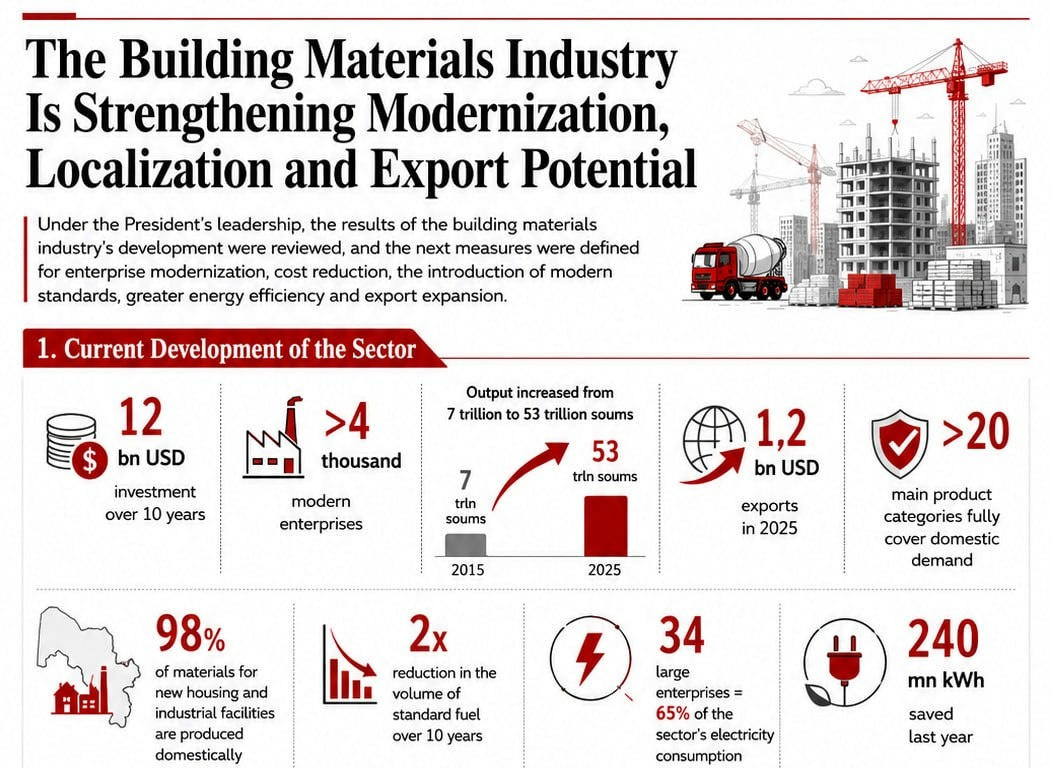
Just ten years ago, domestic construction materials mainly consisted of sand and gravel mixtures, bricks, cement, glass, and slate, accounting for only 30–40% of all materials used in construction. Over the past decade, $12 billion in investment has been attracted into the sector, and more than 4,000 modern enterprises have been launched.
As a result, production capacity has been created to fully meet domestic demand for more than 20 key product categories, including cement, glass, basalt-based materials, ceramic products, aerated concrete blocks, and dry construction mixes. Production of thermal insulation and composite materials, eco-friendly finishing products, flooring, and other high-value-added products is expanding rapidly.
Today, 98% of the materials required for the construction of new residential and industrial buildings are produced domestically. As a result, sector output increased from UZS 7 trillion to UZS 53 trillion, while exports reached $1.2 billion last year. Most importantly, the sector has successfully gone through a major import substitution phase.
Earlier this year, a large-scale housing program was adopted. Under this program, housing construction is expected to double by 2040, reaching 280,000 homes annually, while the number of Yangi Uzbekistan residential complexes will increase from 61 to 120.
In addition, 20–25 million square meters of commercial buildings are commissioned annually. Residential and commercial construction alone generates annual demand for construction materials worth approximately $10 billion.
At the Tashkent International Investment Forum, foreign partners were offered additional infrastructure projects worth $27 billion. These include the nuclear power plant in Jizzakh, the fourth copper processing plant in Tashkent Region, the New Tashkent Airport in O‘rta Chirchiq District with a capacity of 20 million passengers, a 55,000-seat football stadium in New Tashkent, and the 282-kilometer Tashkent–Samarkand highway. Construction materials will be essential for all of these major projects.
Naturally, such large-scale projects require high standards in quality, certification, and technical compliance. In this regard, the need to establish a new system integrating domestic manufacturers into these projects was emphasized.
Investors participating in major and mega-projects have requested VAT exemptions on imported construction materials. At the same time, many domestic manufacturers are ready to supply materials for these projects and are willing to compete on quality and standards, provided VAT preferences also apply to local products.
Officials were instructed to submit a draft resolution ensuring equal conditions for imported and domestic products supplied to major and mega-projects.
The meeting also reviewed implementation of the two-year regional tourism infrastructure development program. Under the program, 34 major tourism facilities and more than 1,000 accommodation facilities, including 200 hotels, are planned for construction.
It was noted that khokims must ensure the share of local materials in newly built regional hotels reaches at least 95%.
Each year, around 65,000 individual houses are built in the country, while another 200,000–250,000 apartments undergo renovation.
“We must say openly that many people are still not sufficiently aware of the benefits of energy-efficient materials,” the President noted.
Residential heating accounts for 20% of total gas consumption in the economy and 11% of electricity consumption. If thermal insulation materials are used for facades and roofs and energy-efficient windows are installed, energy consumption can be reduced by up to 30%.
In this context, a 4,000-apartment Yangi Uzbekistan residential complex is being developed in Kamashi District based on a new design approach developed by French and British companies. Only domestically produced energy-efficient materials are used in this project, reducing construction costs by 20% and heating and cooling expenses by 25–30%.
Regional, district, and city khokims were instructed to study the design approach applied in Kamashi. It was noted that in 33 districts and cities, where the new image of Yangi Uzbekistan will be formed this year, all apartment construction must follow this model.
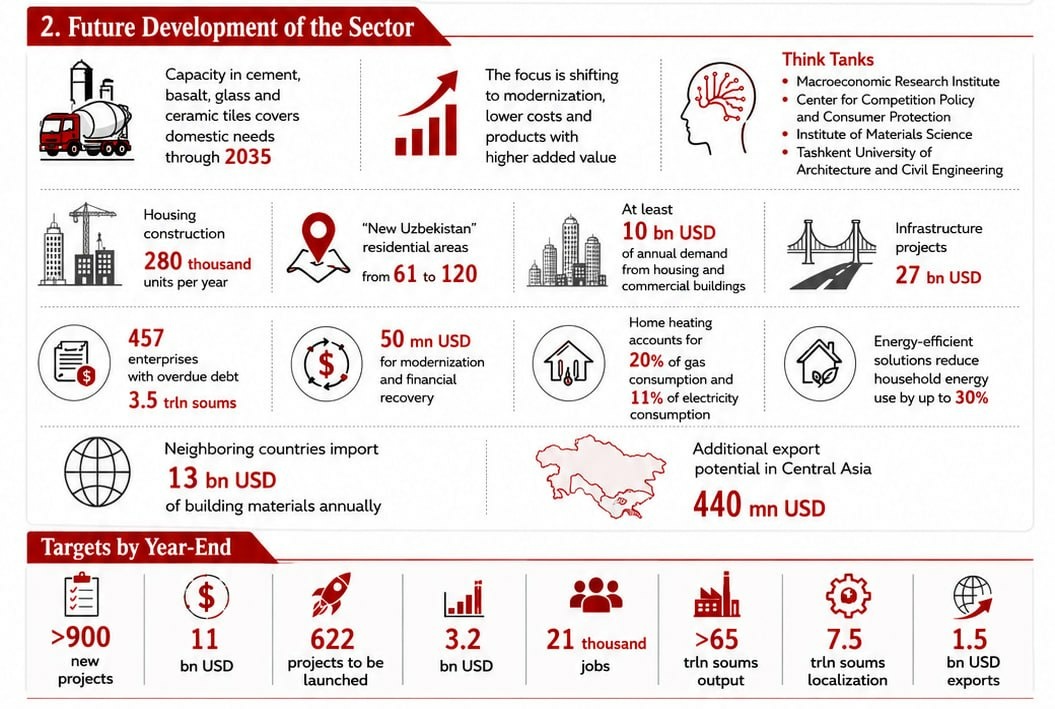
Special attention was also paid to exports. Neighboring countries import construction materials worth $13 billion annually. It was noted that Central Asian markets alone provide potential to increase exports by an additional $440 million.
“Understand one thing: amid intense competition in external markets, where every dollar matters, unconventional solutions are needed to expand exports,” the President said.
Major residential and commercial construction programs are underway in Azerbaijan, Georgia, Russia, Kazakhstan, and Kyrgyzstan. If Uzbekistan becomes a reliable partner in housing construction for these countries, new export opportunities will also emerge for the electronics, home textile, and furniture industries.
Officials were instructed to build 3–4 model energy-efficient houses and conduct roadshows in Baku, Tbilisi, Moscow, Astana, and Bishkek.
The meeting also addressed energy efficiency within the industry itself. Over the past decade, consumption of conventional fuel by construction material producers has been cut by half. Last year alone, 240 million kWh of electricity was saved through energy audits at 34 large enterprises, which account for 65% of the sector’s electricity consumption.
However, this was noted as insufficient. Regional khokims were instructed to launch a large-scale program to reduce energy consumption at construction materials enterprises through technological modernization. Enterprises replacing kilns, drying furnaces, mills, and other energy-intensive equipment with energy-efficient alternatives will receive compensation covering 7% of loans in soums and 4% of loans in foreign currency.
It was emphasized that the country’s existing production capacities for cement, basalt, glass, and ceramic tiles are sufficient to meet demand until 2035. Therefore, investors should now be directed not toward expanding production of these goods, but toward modernizing existing facilities and implementing high-value-added projects.
A system has already been established to fully reimburse construction materials enterprises for all certification-related expenses. No other sector offers such support. However, due to the absence of a unified database of certificates, buyers still often choose foreign products with internationally recognized certifications.
Officials were instructed to launch an electronic platform for construction materials holding both domestic and international certifications, and together with regional khokims assist at least 50 enterprises in obtaining international quality certifications this year.



leave a comment