President Shavkat Mirziyoyev is visiting Namangan region these days. During the trip, the Head of State is reviewing ongoing construction and improvement works, implemented projects and new solutions introduced in various sectors.
In this context, the Center for Economic Research and Reforms analyzed the socio-economic development dynamics of Namangan region for 2021–2025. The analysis shows that the region maintains stable economic growth, expands investment and entrepreneurial activity, and strengthens its export potential.
At the next stage, the key issue for the region will be the quality of growth, primarily through higher productivity, development of processing industries, expansion of export geography and more balanced development of districts.
Macroeconomic Dynamics
By the end of 2025, the gross regional product of Namangan region increased by 8.2% and exceeded 85.4 trillion soums. The region’s share in the national economy reached 4.6%. GRP per capita amounted to 27 million soums, increasing by 6% compared to the previous year.
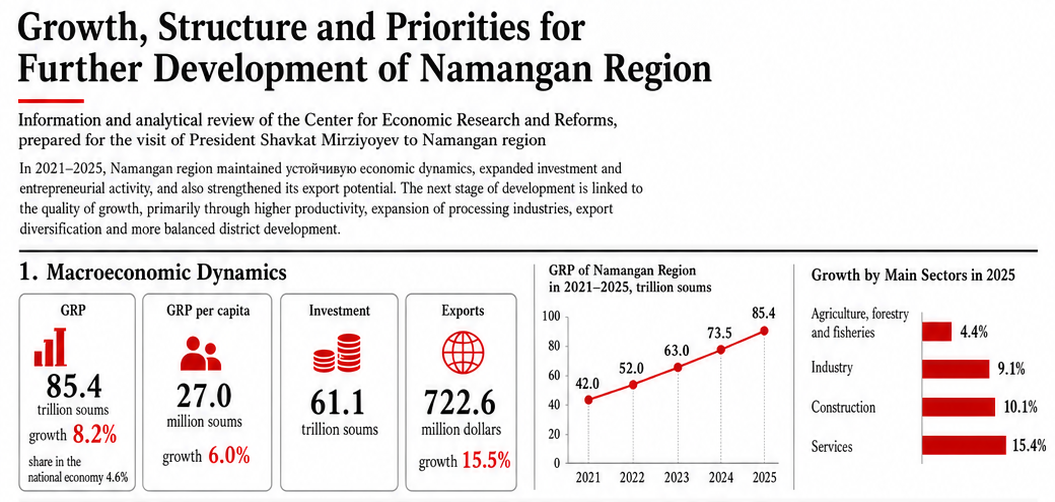
In 2021–2025, the region’s GRP grew from 42 trillion to 85.4 trillion soums. Thus, over five years, the regional economy more than doubled in nominal terms.
Growth was supported by all major sectors. In 2025, agriculture, forestry and fisheries grew by 4.4%, industry by 9.1%, construction by 10.1% and services by 15.4%.
This dynamic shows that the regional economy is becoming more balanced. Growth is being formed not only in traditional sectors, but also in areas that determine business activity, employment and domestic demand.
Economic Structure
One of the main factors behind the growth of Namangan region has been the services sector. In 2025, the volume of market services reached 56.3 trillion soums and increased by 15.4% compared to the previous year. This is higher than the national average, which stood at 14.7%.
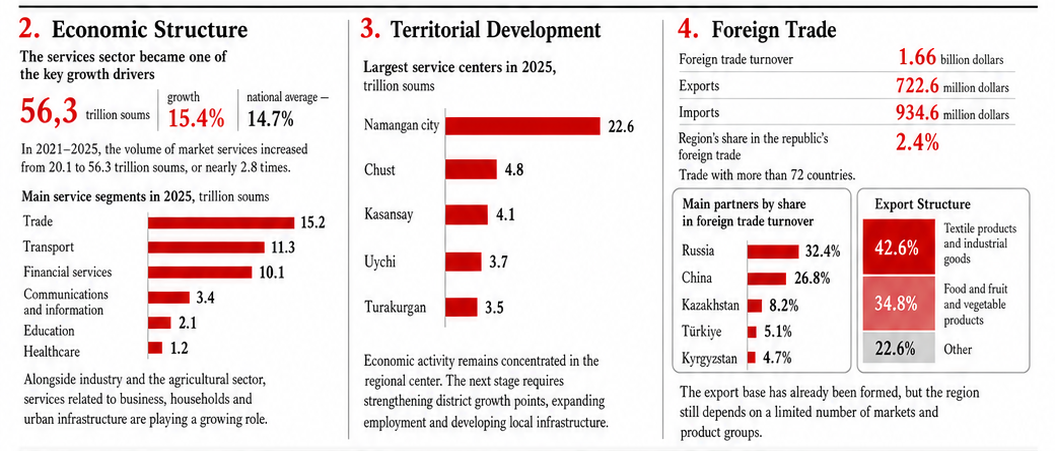
In 2021–2025, the volume of market services increased from 20.1 trillion to 56.3 trillion soums, or almost 2.8 times. This reflects the expansion of the domestic market, income growth, development of the urban economy and increased business activity.
Trade, transport and the financial sector lead the structure of services. Trade services amounted to 15.2 trillion soums, transport services to 11.3 trillion soums and financial services to 10.1 trillion soums. Communications and information services, education and healthcare are also developing
For the region, this is an important structural shift. Namangan retains its industrial and agricultural potential, while sectors related to serving businesses, the population and urban infrastructure are playing an increasingly important role.
Territorial Development
Economic activity in the region is still mainly concentrated in the city of Namangan. The regional center accounts for 22.6 trillion soums of services. This is explained by the concentration of trade, finance, transport, education, healthcare and administrative functions.
At the same time, individual districts are already forming their own growth points. Among them are Chust with 4.8 trillion soums of services, Kasansay with 4.1 trillion soums, Uychi with 3.7 trillion soums and Turakurgan with 3.5 trillion soums.
At the next stage, it will be important to focus on the development of districts, which will help expand employment and reduce territorial disparities.
This requires local production projects, development of services, improved transport connectivity, entrepreneurial infrastructure and the creation of new jobs in districts.
Foreign Trade
In 2025, the foreign trade turnover of Namangan region reached 1.66 billion dollars and increased by 15.4%. Exports amounted to 722.6 million dollars, while imports reached 934.6 million dollars. The region’s share in the national foreign trade turnover stood at 2.4%.
The region traded with more than 72 countries. Its main partners were Russia, China, Kazakhstan, Türkiye and Kyrgyzstan. Russia accounted for 32.4% of foreign trade turnover, China for 26.8%, Kazakhstan for 8.2%, Türkiye for 5.1% and Kyrgyzstan for 4.7%.
The main export destinations were Russia, Kyrgyzstan, Kazakhstan, Türkiye and Tajikistan. Their combined share in the region’s exports reached 67.3%.
Exports are mainly formed by textile products and industrial goods, which account for 42.6%, as well as food products and fruit and vegetable products, which account for 34.8%. Imports are dominated by machinery and transport equipment, industrial goods, chemical products and other goods.
Thus, while Namangan region has a developed export base, it still depends on a limited number of markets and product groups. Therefore, further development requires diversification of supplies and an increase in the share of products with higher added value.
Small Business and Entrepreneurship
Small business remains a key driver of the economy of Namangan region. In 2025, its share in GRP amounted to 73.6%, or 62.8 trillion soums. This sector accounts for around 82% of the employed population in the region.
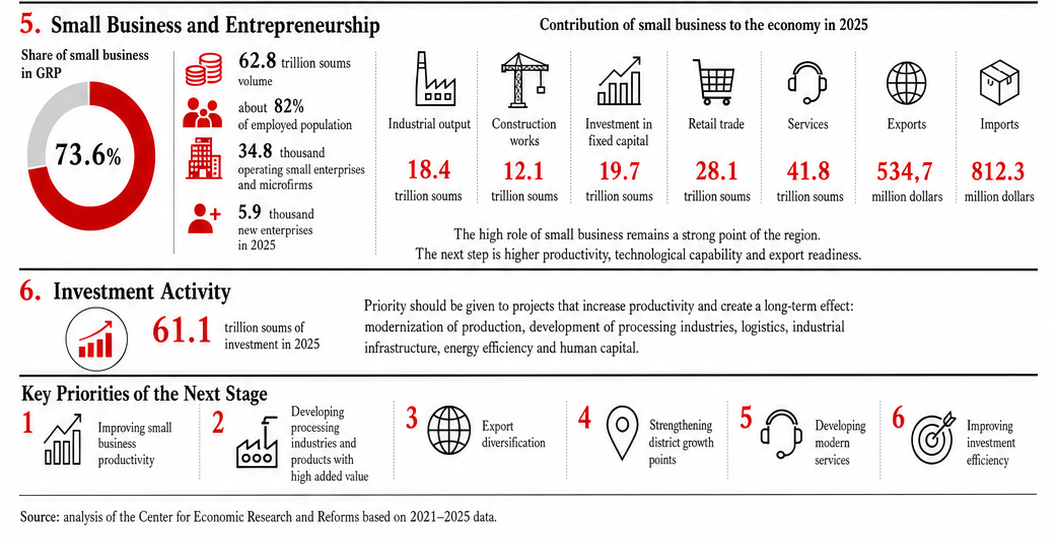
Entrepreneurship in Namangan performs not only an economic but also a social function, providing employment, household incomes and the development of trade, services, production and exports.
By the end of 2025, 34.8 thousand small enterprises and microfirms were operating in the region, which is 12.1% more than a year earlier. During the year, 5.9 thousand new small enterprises and microfirms were created, excluding farms and dehkan farms.
New entities were mainly established in trade, industry, agriculture and services, which indicates that entrepreneurial activity is distributed across several sectors and is not concentrated in only one area.
In 2025, small entrepreneurs produced industrial goods worth 18.4 trillion soums, carried out construction works worth 12.1 trillion soums and utilized 19.7 trillion soums of fixed capital investment. They also generated 28.1 trillion soums in retail trade turnover, 41.8 trillion soums in services, 534.7 million dollars in exports and 812.3 million dollars in imports.
The high share of small business is a strong side of the region. At the same time, further development requires a transition to higher productivity, greater technological capacity and export readiness.
Investment Activity
In 2025, 61.1 trillion soums of investment were directed to the economy of Namangan region. This confirms the growth of the region’s investment attractiveness and creates a basis for the expansion of production, construction, infrastructure and services.
However, at the next stage, not only the volume of investment but also its direction will be important. For Namangan, priority should be given to projects that increase productivity and create a long-term effect.
These include, above all, modernization of production, development of processing industries, logistics, industrial infrastructure, energy efficiency and human capital. Such investments not only expand the economy but also increase its competitiveness.
New Development Priorities for the Region
Following his visit to Namangan region, President Shavkat Mirziyoyev held a meeting at the regional situational center, where issues of economic and infrastructure development of the region were discussed.
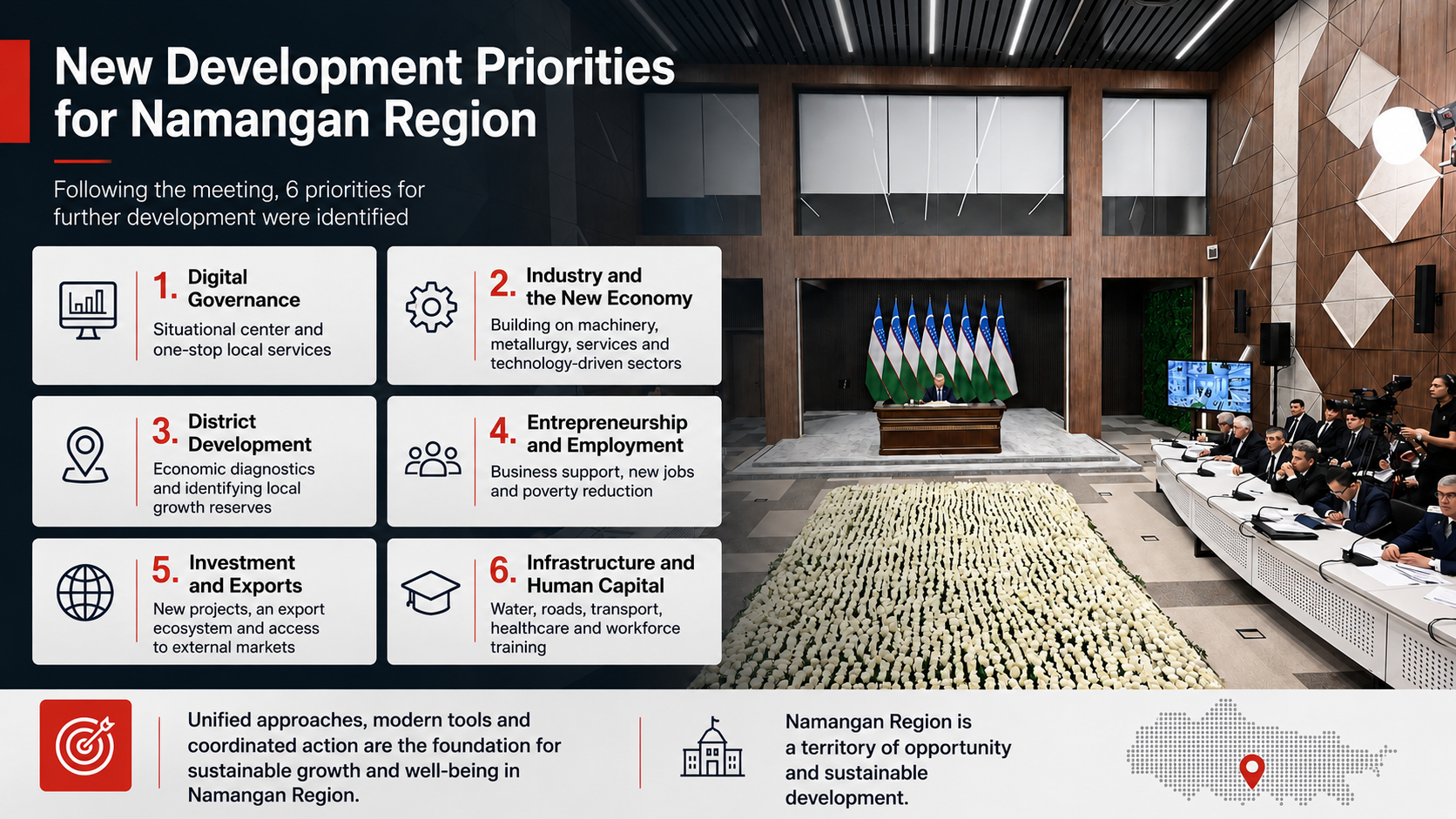
The agenda of the meeting shows a shift from general growth dynamics to a more practical task — improving the manageability of development, identifying local reserves and accelerating practical decisions in districts and cities. Particular attention was paid to digital governance, industrial development, entrepreneurship, employment, infrastructure, exports and human capital.
Main Areas of Further Development
1. Digital governance and local services
A “smart” situational center has been created in Namangan. It allows processes in cities and districts to be analyzed through a unified digital system and helps management decisions be made more quickly.
An “Information and Service Center of the Mahalla” is being established in the Yangi Namangan mahalla of Naryn district. Through this center, more than 27 thousand residents of 8 mahallas will be able to receive 980 types of services on a one-stop-shop basis. Data related to social protection, employment, crime prevention, taxes, education and other indicators will be integrated into a unified digital system.
This should increase the speed and targeting of decisions at the local level and reduce the distance between the needs of the population and the work of government bodies.
2. New industrial and economic specialization
At the meeting, it was noted that in recent years industrial production in Namangan has increased from 4.6 trillion to 40 trillion soums. This year, targets have been set to ensure growth of gross regional product by 9.2%, industry by 9%, services by 17% and agriculture by 6.8%.
Mechanical engineering, metallurgy, light industry, services and areas of the “new economy” have been identified as the main growth areas. This means that the regional development model should rely not only on traditional sectors, but also on more technological and productive industries.
3. A science-based approach to district development
To strengthen analysis and identify reserves, 14 “think tanks” across the country will switch to a new working format based on the Namangan model. They will conduct economic diagnostics of districts and cities and identify reserves for growth in labor productivity, investment quality, cooperation, business activity and value chains.
This approach should strengthen the practical role of analytics. Research and analytical work should not remain at the level of recommendations, but should be implemented in specific programs for the development of regions and sectors.
4. Entrepreneurship, employment and poverty reduction
This year, 4.5 trillion soums have been allocated from the budget to Namangan region for the development of business infrastructure. In addition, 6.5 trillion soums of resources are being directed to support small and medium-sized businesses.
By the end of the year, the task has been set to provide permanent employment for 80 thousand people, increase the incomes of 314 thousand citizens and lift 21 thousand families out of poverty. In the first five months, 23.5 thousand people have already received permanent jobs, and more than 8 thousand families have been lifted out of poverty.
This area is particularly important for Namangan, where small business plays a major role in employment and household incomes. The next stage requires not only the creation of jobs, but also higher income levels, productivity and sustainability of entrepreneurship.
5. Investment and export ecosystem
This year, the goal is to attract 5 billion dollars of foreign investment to Namangan region and increase exports to 1.2 billion dollars. Within the framework of the fifth Tashkent International Investment Forum, agreements were reached on the implementation of 43 projects worth 3 billion dollars in the region.
To increase export potential, work has been assigned for each district and city. It is also planned to introduce a unified export ecosystem covering the entire process — from production to standardization, certification, packaging, logistics and customs clearance.
This should help the region move from the growth of export volumes to more systematic work with markets, product quality and added value.
6. Infrastructure, transport and human capital
A significant part of the tasks is related to infrastructure. This year, 703 billion soums have been allocated for the construction of 130 kilometers of water supply networks, 2.5 kilometers of sewerage networks and 9 new water facilities. As a result, 34 thousand residents will receive centralized water supply for the first time, while 25 thousand citizens will be connected to the sewerage system.
The reconstruction of the 75-kilometer section of the Pungan — Namangan road is also planned, turning it into a four-lane concrete highway, along with the construction of 21 bridges and 22 pedestrian crossings. To develop public transport, it was instructed to purchase 90 buses, 50 electric buses and 30 minibuses by September 1, and an additional 105 electric buses by July 1 of next year.
Special attention was also paid to workforce training. At least five private training and assessment centers meeting international standards are planned to be established in Namangan, with 20 thousand young men and women to begin training already this year. This should support the development of modern professions and provide new sectors of the economy with qualified personnel.
In healthcare, a new model of primary healthcare is planned to be introduced in Kasansay and Uychi districts. In addition, starting in October, a national program to combat myocardial infarction and stroke will be launched in Namangan, Andijan and Fergana regions.
Thus, the new development priorities of Namangan region are aimed at moving from the expansion of economic activity to a more manageable and higher-quality growth model. This model includes digital governance, industrial specialization, entrepreneurship, employment, exports, infrastructure and workforce training. These are the areas that should define the next stage of the region’s development.
Center for Economic Research and Reforms
Namangan Branch



leave a comment