
Mutual Trade of Central Asia in January–May 2026
CERR has prepared an infographic on the dynamics of mutual trade among Central Asian countries for January–May 2026.

Following the results of January–May 2026, mutual trade among the Central Asian states continues to show steady growth. Over the 5-month period, the volume increased by 26.8% to $5.4 billion.
The sum of each country's export shipments to other Central Asian states is used as an indicator of intraregional trade. This approach avoids double counting, as the same operation is reflected as exports from one country and imports into another. For Turkmenistan, mirror data from the national statistics of Central Asian countries were used.
The growth in mutual trade was driven by an increase in export shipments from all Central Asian countries. The highest rates were demonstrated by Turkmenistan at 31.8%, Uzbekistan at 31.5%, and Kazakhstan at 27%. Tajikistan's exports to the region increased by 20.6%, while Kyrgyzstan's grew by 5.8%.
At the same time, the main absolute gain was generated by Kazakhstan and Uzbekistan, which account for 83% of intraregional deliveries. In the structure of mutual exports, the leading role belongs to Kazakhstan. In January–May 2026, its shipments to Central Asian countries amounted to $3.2 billion, or 59.1% of the total figure. Uzbekistan accounted for $1.3 billion, or 23.9%. The share of Turkmenistan was 8.6% ($464 million), Kyrgyzstan accounted for 5.8% ($312 million), and Tajikistan made up 2.5% ($135 million).
The region's largest trade direction is the exchange between Kazakhstan and Uzbekistan. According to national statistics from both sides, bilateral trade volume for the five months of 2026 exceeded $2.3 billion.
The second group of major trade routes consists of Kazakhstan's trade with Kyrgyzstan and Tajikistan, as well as Uzbekistan's ties with Kyrgyzstan, Tajikistan, and Turkmenistan.
Meanwhile, trade exchange between Kyrgyzstan and Tajikistan, Kyrgyzstan and Turkmenistan, and Tajikistan and Turkmenistan remains minor. This indicates limited diversification of intraregional ties and weak participation of smaller economies in unified value chains.
By the nature of their participation in mutual trade, the countries of the region can be conditionally divided into two groups. Kazakhstan and Turkmenistan act primarily as regional net exporters. Uzbekistan, Kyrgyzstan, and Tajikistan are net importers. Kazakhstan's surplus in mutual trade stood at about $2.2 billion. At the same time, the negative balance approached $1 billion for Uzbekistan, $683 million for Tajikistan, and $588 million for Kyrgyzstan.
In January–May 2026, Kazakhstan's trade turnover with Central Asian countries reached $4.2 billion, an increase of 28.9%. Exports grew by 27% to $3.2 billion, while imports rose by 36% to $991.4 million. Furthermore, exports exceeded imports by more than 3 times.
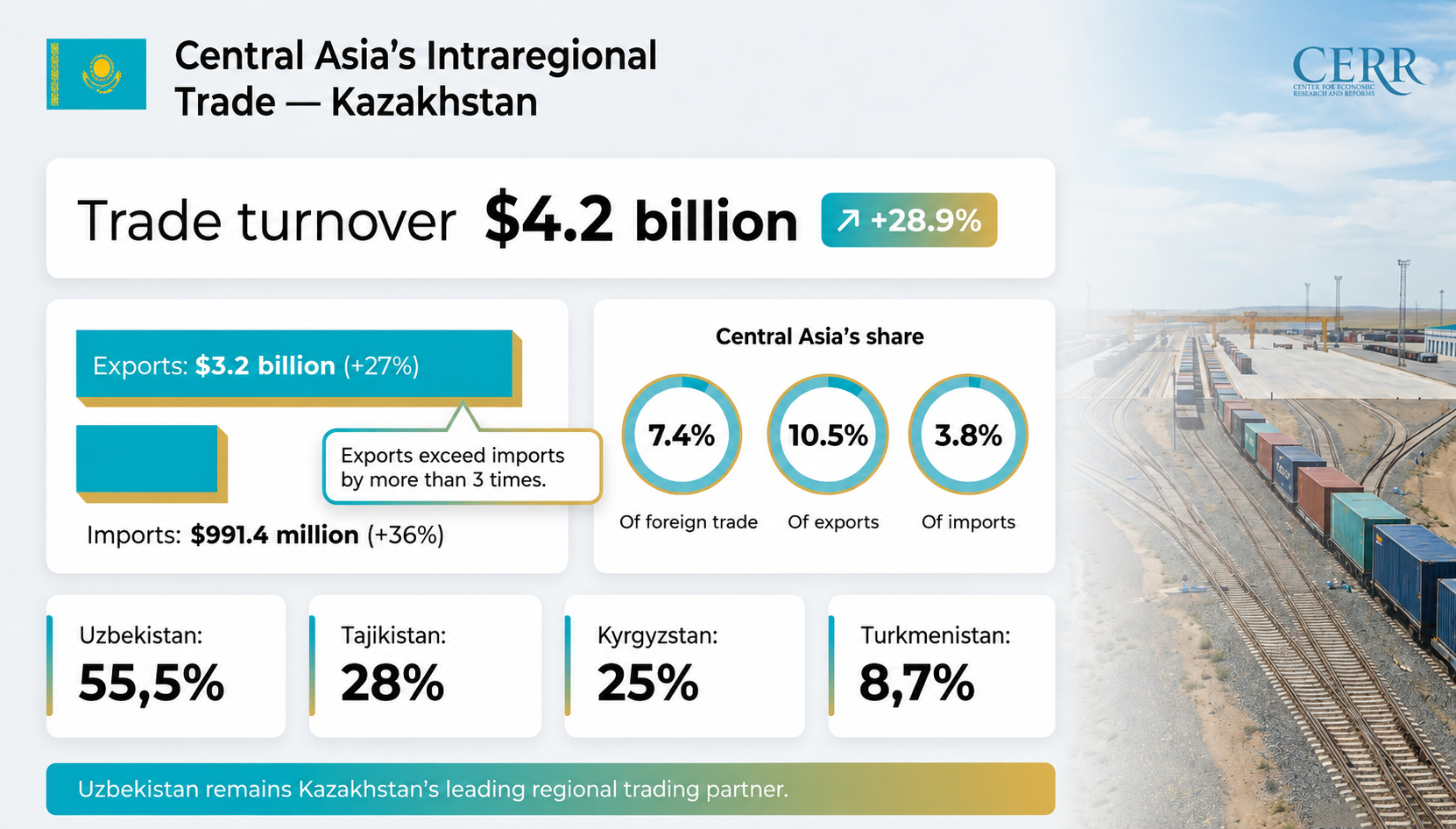
Central Asia accounted for 7.4% of Kazakhstan's total foreign trade turnover, including 10.5% of exports and 3.8% of imports.
Uzbekistan remains its main partner, accounting for 55.5% of Kazakhstan's trade with the countries of the region. It is followed by Kyrgyzstan (25%), Tajikistan (28%), and Turkmenistan (8.7%).
Uzbekistan's trade turnover with Central Asian countries reached $3.5 billion, increasing by 32%. Exports grew by 32% to $1.3 billion, and imports rose by 34% to $2.3 billion.
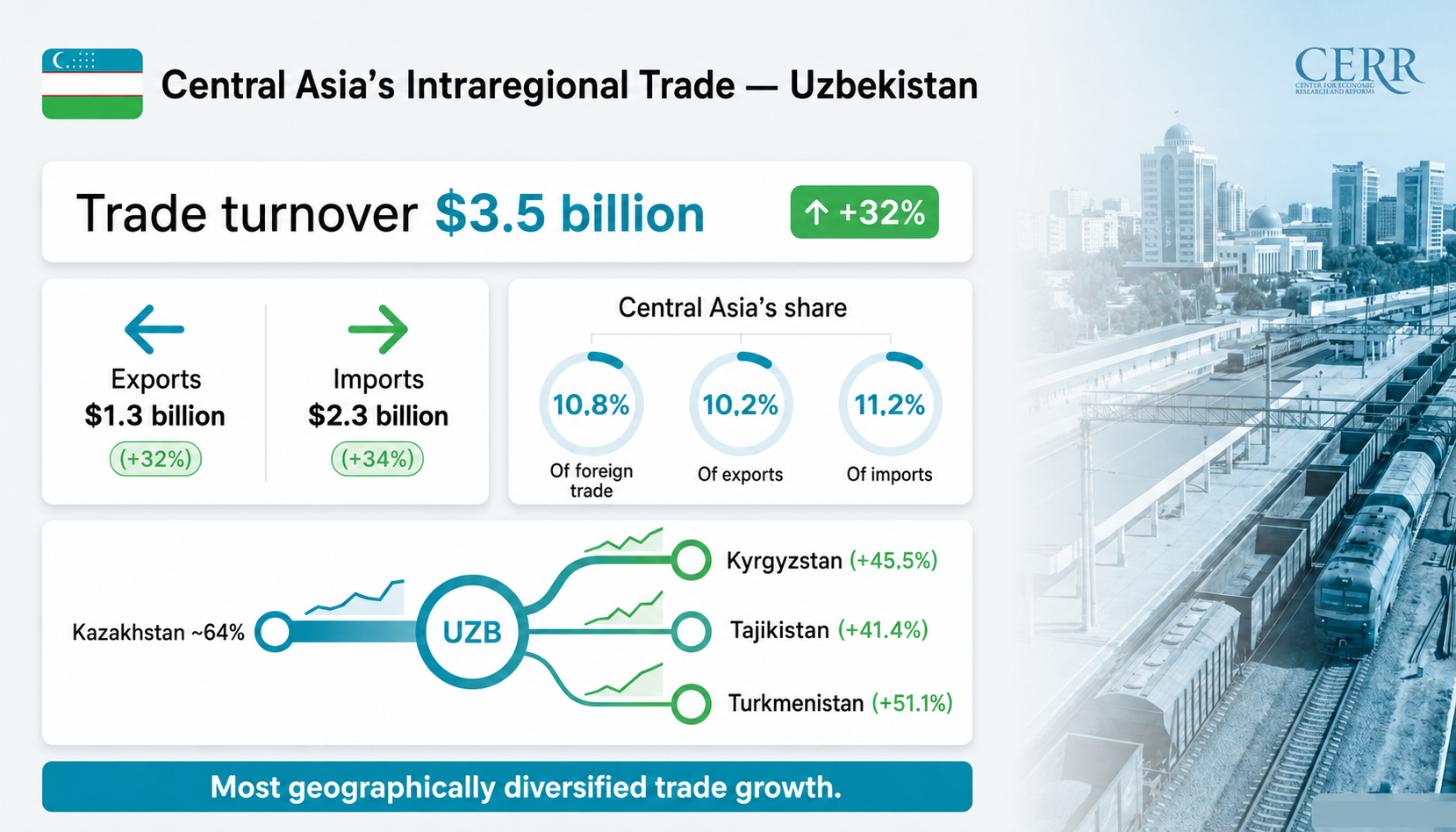
The region's states accounted for 10.8% of Uzbekistan's total foreign trade turnover, including 10.2% of exports and 11.2% of imports.
Kazakhstan provided about 64% of Uzbekistan's trade with the region. A feature of 2026 was the rapid growth of trade with other countries; in particular, trade turnover with Kyrgyzstan increased by 45.5%, with Tajikistan by 41.4%, and with Turkmenistan by 51.1%. Thus, Uzbekistan demonstrates the most geographically diversified trade dynamics.
It is also worth noting that a significant deficit does not necessarily indicate a deterioration in trade positions. Part of the imports consists of raw materials and intermediate goods used in production.
Kyrgyzstan's trade turnover with Central Asian countries reached $1.2 billion, up by 14.2%. Imports totaled $900 million, while exports amounted to $312 million. Kyrgyzstan's exports to Central Asia increased by only 5.8%, which is the lowest indicator in the region. Imports grew faster, rising by 14%.
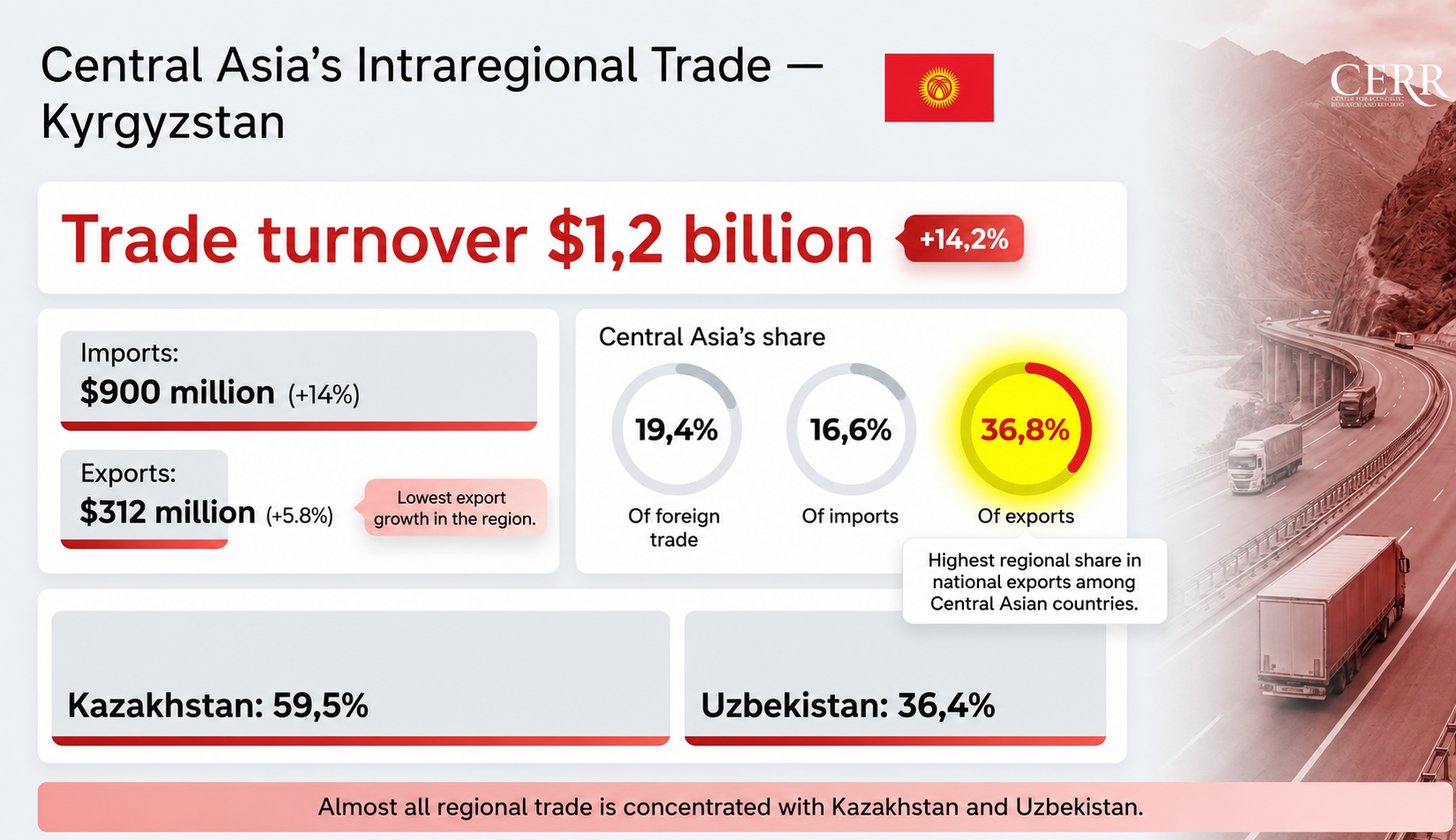
Central Asian countries accounted for 19.4% of Kyrgyzstan's total foreign trade, 16.6% of its imports, and 36.8% of its exports. This is the highest share of the region in national exports among all Central Asian countries.
The main partner is Kazakhstan, making up 59.5% of Kyrgyzstan's regional trade. Second place is held by Uzbekistan at 36.4%. Practically all of Kyrgyzstan's regional exchange is concentrated on the Kazakh and Uzbek routes.
Tajikistan's trade turnover with Central Asian countries amounted to $952 million, an increase of 29%. Imports reached $818 million, while exports stood at $135 million.
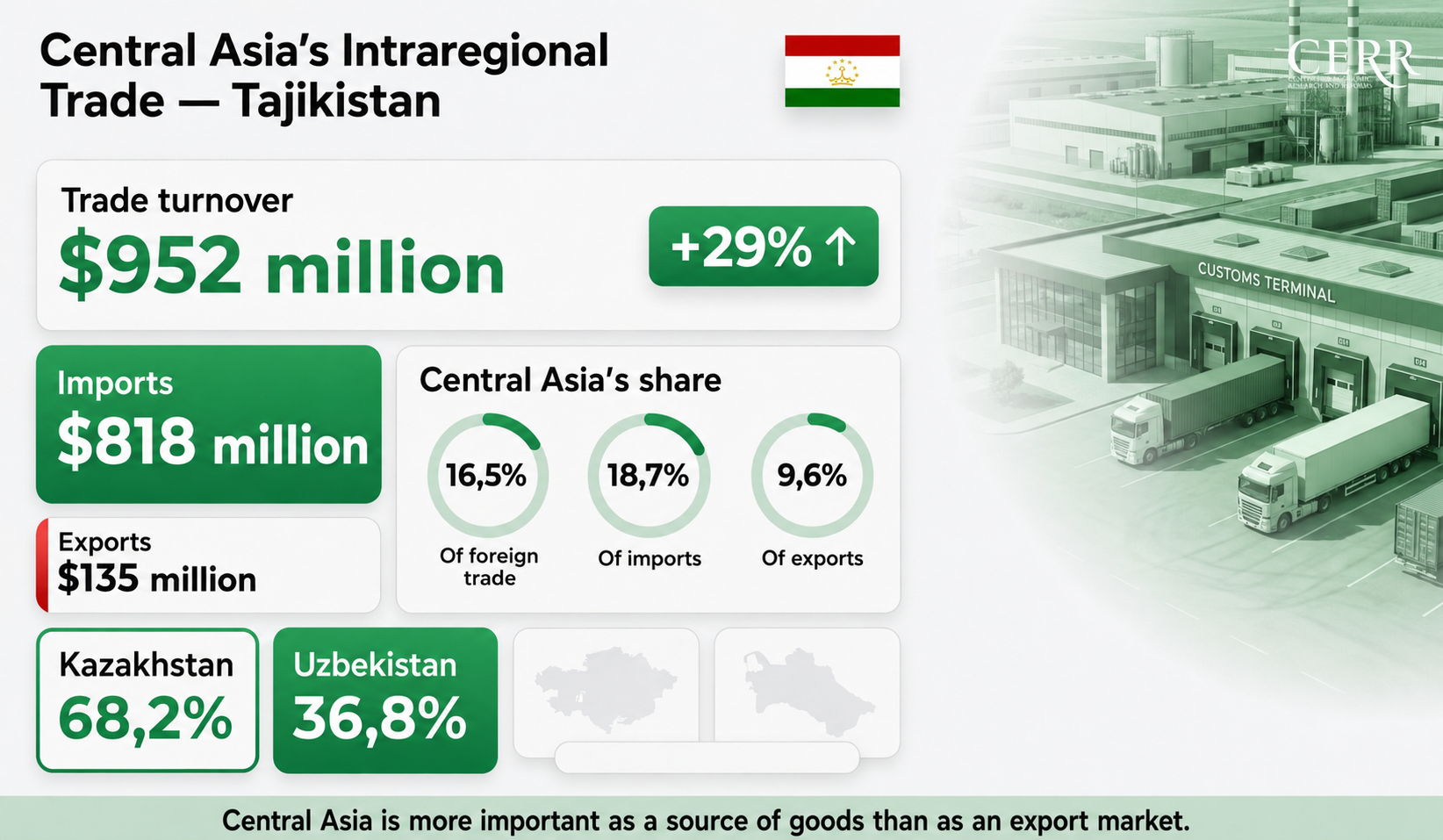
The region accounted for 16.5% of Tajikistan's total foreign trade, including 18.7% of imports and only 9.6% of exports. Central Asia is more important for the country as a source of goods than as a sales market.
Kazakhstan maintains a dominant position, accounting for 68.2% of Tajikistan's trade with the region. Uzbekistan's share is 36.8%. Trade volume with Kyrgyzstan and Turkmenistan remained small.
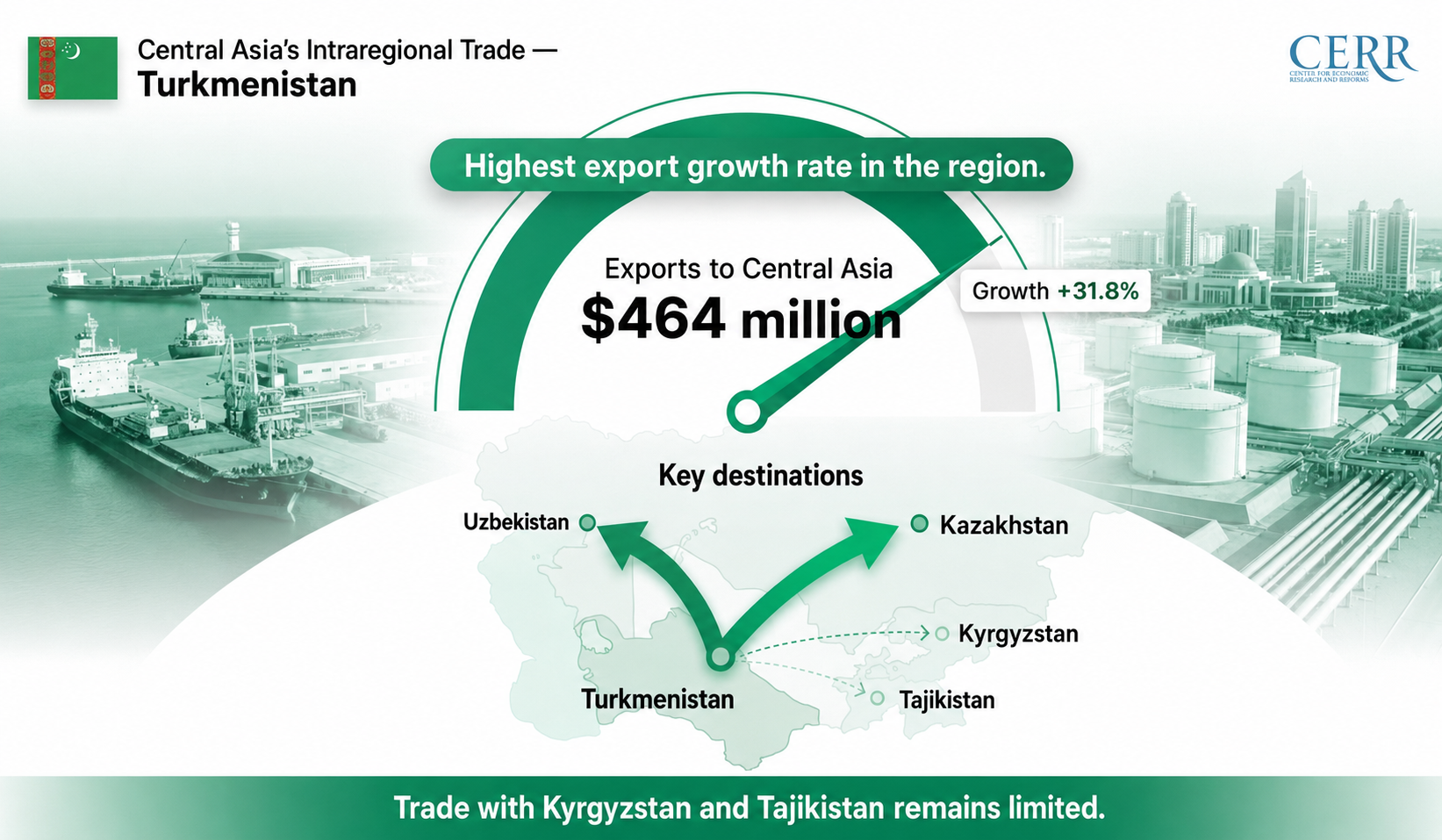
Turkmenistan's exports to Central Asian countries totaled $464 million, an increase of 31.8%. The main destinations were Uzbekistan and Kazakhstan. Trade with Kyrgyzstan and Tajikistan remained limited.
Overall, the results of January–May 2026 confirm that intraregional trade is becoming one of the most dynamic segments of foreign economic relations for Central Asian countries. High trade dynamics evidence the further expansion of economic ties within the region.
At the same time, quantitative growth is not yet accompanied by a comparable deepening of regional economic integration. The main portion of trade flows continues to be concentrated around Kazakhstan and Uzbekistan, whereas direct ties between Kyrgyzstan, Tajikistan, and Turkmenistan remain limited.
From this perspective, there is a clear demand for further strengthening measures by the region's countries to scale up cooperation, deepen existing value chains, and establish new ones.
Ruslan Abaturov, CERR


Izoh qoldirish