Avvalroq kambag‘allik darajasi yuqori bo‘lgan 37 ta «og‘ir» tuman va 903 ta «og‘ir» mahalla belgilangan edi. 2026 yil uchun maqsadli ko‘rsatkichlar ham tasdiqlangan. Kambag‘allik darajasini 2,8 foizgacha, ishsizlikni 4,5 foizgacha pasaytirish rejalashtirilgan. 1 mln kishi doimiy ish bilan ta’minlanishi, 4 mln kishining daromadini oshirish vazifasi belgilangan. Kambag‘allik va ishsizlikdan xoli mahallalar soni 3,5 mingtaga yetkaziladi. Shuningdek, 1 mln norasmiy ish o‘rnini legallashtirish va 120 ming nafar mutaxassisni talab yuqori bo‘lgan kasblarga o‘qitish nazarda tutilgan.
2026 yilning I choragida 37 ta «og‘ir» tuman va 903 ta «og‘ir» mahallani jadal rivojlantirish uchun respublika byudjetidan 3,6 trln so‘m ajratildi. Shu davrda 167 ming kishi doimiy ish bilan ta’minlandi. Yana 737 ming fuqaro qo‘shimcha daromad manbalarini yaratish bo‘yicha xizmatlar oldi. 241 ming nafar norasmiy band fuqaro legal sektorga o‘tkazildi. Biznesni qo‘llab-quvvatlash dasturlari doirasida 8 trln so‘m kredit resurslari yo‘naltirildi.
Prezidentning yangi farmoni amaldagi tartibni aniqlashtiradi. Hujjat «og‘ir» mahallalar bilan ishlashning moliyaviy, shartnomaviy va tashkiliy mexanizmlarini kuchaytiradi. O‘zgarishlarning asosiy vazifasi kambag‘allikni qisqartirish choralarini islohot dasturlari, moliyalashtirish manbalari, jamoatchilik nazorati va tadbirkorlik loyihalarini bozorga olib chiqish bilan uyg‘unlashtirishdan iborat.
Asosiy o‘zgarishlar
- «Og‘ir» mahallalar qamrovi kengaytiriladi
«Og‘ir» mahallalar ro‘yxati 12 taga ko‘payib, 915 taga yetkaziladi. Ushbu hududlarga maxsus qo‘llab-quvvatlash choralari qo‘llaniladi. Ular islohot dasturlarini moliyalashtirish, oilaviy tadbirkorlik uchun imtiyozli kreditlar ajratish va tadbirkorlik loyihalarini amalga oshirishda ko‘maklashishni o‘z ichiga oladi.
- Moliyalashtirishning yangi formulasi joriy etiladi
Har bir «og‘ir» mahallaning «islohot dasturi»ni moliyalashtirish uchun tegishli mahalliy byudjetdan ajratilgan har 1 mlrd so‘mga respublika byudjetidan 2 mlrd so‘m yo‘naltiriladi. Natijada mahalliy byudjetning 1 mlrd so‘mlik ulushi qo‘shimcha manbalarni hisobga olmaganda 3 mlrd so‘mlik umumiy moliyaviy paketni shakllantiradi.
Mahalliy darajaning loyihalarni tayyorlashdagi roli oshadi. Tuman yoki viloyat o‘z mablag‘i bilan ishtirok etadi, respublika byudjeti esa hududning moliyaviy ishtiroki bilan tasdiqlangan loyihalarni kengaytiradi.
- Moliyalashtirish manbalari kengaytiriladi
Mahalliy byudjet mablag‘lari bilan bir qatorda Qoraqalpog‘iston Respublikasi Vazirlar Kengashi va viloyat hokimliklari huzuridagi tadbirkorlik infratuzilmasini rivojlantirish jamg‘armalari mablag‘laridan foydalanishga ruxsat etiladi.
Shu orqali rivojlanish dasturlarining mahalliy byudjet imkoniyatlariga bog‘liqligi kamayadi. Ijtimoiy va tadbirkorlik infratuzilmasi loyihalari bir nechta manba hisobidan moliyalashtiriladi. Ushbu norma byudjet daromadlari cheklangan hududlar uchun alohida ahamiyatga ega.
- Ijtimoiy shartnoma joriy etiladi
«Islohot dasturi»ni amalga oshirish doirasida tuman yoki shahar hokimligi, mahalla fuqarolar yig‘ini hamda bandlik va kambag‘allikni qisqartirish bo‘limi o‘rtasida kambag‘allikni qisqartirishga qaratilgan ijtimoiy shartnoma tuziladi.
Ijtimoiy shartnoma qo‘llab-quvvatlashni o‘zaro majburiyatlar formatiga o‘tkazadi. Hokimlik tashkil etish va muvofiqlashtirish uchun javob beradi. Mahalla joylardagi ehtiyojlarni aniqlashda ishtirok etadi. Bandlik va kambag‘allikni qisqartirish bo‘limi bandlik, daromadlar va oilalarni qo‘llab-quvvatlash choralarini hamrohlik qiladi.
- Kengashlar jamoatchilik nazoratini amalga oshiradi
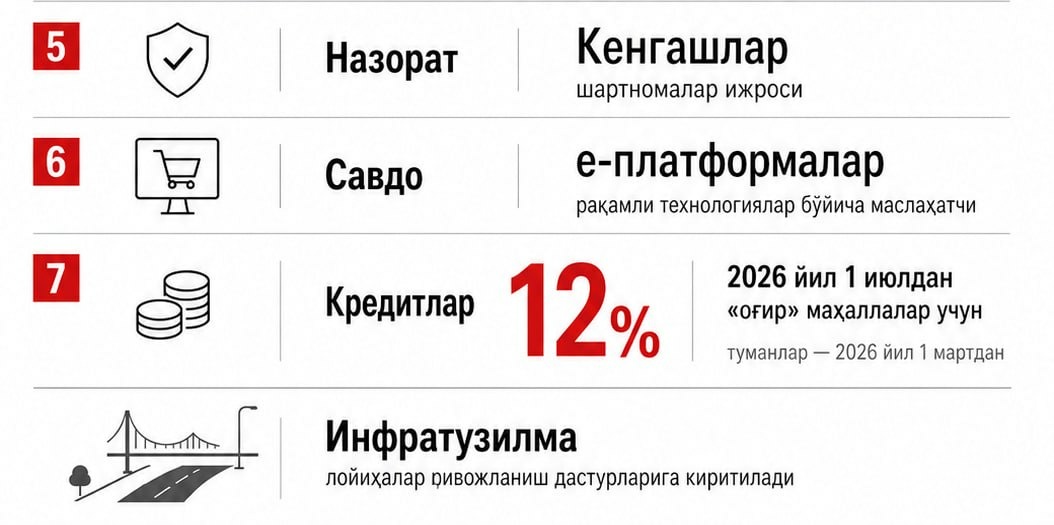
Tuman va shahar xalq deputatlari Kengashlari ijtimoiy shartnomalar ijrosi ustidan jamoatchilik nazoratini amalga oshiradi. Dastur ijrosini faqat mablag‘larni o‘zlashtirish bo‘yicha emas, ijtimoiy shartnomada belgilangan majburiyatlarning bajarilishi bo‘yicha ham baholash mumkin bo‘ladi.
- Tadbirkorlarga elektron savdo platformalariga chiqishda ko‘mak beriladi
Tuman yoki shahar hokimining raqamli texnologiyalar va sun’iy intellekt texnologiyalarini rivojlantirish bo‘yicha maslahatchisiga qo‘shimcha vazifa yuklanadi. U mahallalarda amalga oshirilayotgan tadbirkorlik loyihalari doirasida ishlab chiqarilgan mahsulotlar, xizmatlar va ishlar haqidagi ma’lumotlarni elektron savdo platformalariga joylashtirish orqali ularni sotishga ko‘maklashadi.
Mahsulot va xizmatlarni elektron savdo platformalariga joylashtirish sotuv kanallarini kengaytirishi va oilaviy hamda kichik tadbirkorlik tashabbuslarining barqarorligini oshirishi kutilmoqda.
- «Og‘ir» mahallalar uchun 12 foizlik kreditlar joriy etiladi
«Og‘ir» mahallalarda oilaviy tadbirkorlikni rivojlantirish dasturlari doirasida kreditlar yillik 12 foiz stavkada ajratiladi.
«Og‘ir» tumanlar uchun ushbu stavka 2026 yil 1 martdan qo‘llanila boshlagan. «Og‘ir» mahallalar uchun mexanizm 2026 yil 1 iyuldan ishga tushadi.
Imtiyozli stavka oilalar uchun qarz mablag‘lari qiymatini pasaytiradi. Bu oilaviy biznes, xizmat ko‘rsatish, hunarmandchilik, savdo, tomorqa xo‘jaligi yoki boshqa kichik loyihani boshlash yoki kengaytirish imkonini oshiradi.
- Infratuzilma loyihalari rivojlanish dasturlariga kiritiladi
Farmon «og‘ir» tumanlarni kompleks rivojlantirish dasturlari va «og‘ir» mahallalarning «islohot dasturlari»ga kiritilgan ijtimoiy va tadbirkorlik infratuzilmasi loyihalarini amalga oshirishni nazarda tutadi.
Ushbu norma infratuzilma cheklovlarini dasturiy asosda hal qilish imkonini beradi. Yo‘llar, muhandislik tarmoqlari, ijtimoiy soha ob’yektlari va tadbirkorlik uchun sharoitlar tasdiqlangan dasturning bir qismiga aylanadi. Ular uchun moliyalashtirish manbalari va nazorat mexanizmlari belgilanadi.
Yangi tartib «og‘ir» mahallalar bilan ishlashning yagona zanjirini shakllantiradi. U islohot dasturi, mahalliy ulush, respublika byudjetidan qo‘shimcha mablag‘, hududiy jamg‘armalar resurslari, ijtimoiy shartnoma, jamoatchilik nazorati va tadbirkorlarni bozorga chiqarishga ko‘maklashishni o‘z ichiga oladi.



Izoh qoldirish